Since my December 2, 2005 Non-Hodgkin Lymphoma diagnosis, I've been on a slow-motion journey of survivorship. Chemo wiped out my aggressive disease in May, 2006, but an indolent variety is still lurking. I had my thyroid removed due to papillary thyroid cancer in 2011, and was diagnosed with recurrent thyroid cancer in 2017. Join me for a survivor's reflections on life, death, faith, politics, the Bible and everything else.
I ran across an older article today that I had somehow missed when it came out (oh, I know why I missed it — I had just gotten out of the hospital at the time, recovering from my pulmonary embolisms and complications thereof). On January 4, 2014, George Johnson writes, in a New York Times article called “Why Everyone Seems to Have Cancer”:
“The rhetoric about the war on cancer implies that with enough money and determination, science might reduce cancer mortality as dramatically as it has with other leading killers — one more notch in medicine’s belt. But what, then, would we die from? Heart disease and cancer are primarily diseases of aging. Fewer people succumbing to one means more people living long enough to die from the other.”
I’ve written about this phenomenon on other occasions. In most cases, tt’s not that cancer is increasing, due to pathogens in the environment or from whatever other cause you may care to name: we’re just living longer because other threats to human survival have been minimized. And the older we get, the more our cells become subject to mutations that can result in cancer.
Something similar is happening with Alzheimer’s Disease, that’s likewise on the rise. It’s a disease of the aged, so if you increase the number of the aged, you’re going to see more disease.
Johnson continues:
“[Cancer] is not so much a disease as a phenomenon, the result of a basic evolutionary compromise. As a body lives and grows, its cells are constantly dividing, copying their DNA — this vast genetic library — and bequeathing it to the daughter cells. They in turn pass it to their own progeny: copies of copies of copies. Along the way, errors inevitably occur. Some are caused by carcinogens but most are random misprints.”
Remarkable progress has been made, Johnson points out, in reducing or curing childhood cancers — mortality from childhood cancers has fallen by more than 50% since 1975. When specific cancers are caused by carcinogens — such as tobacco smoke in the case of lung cancer, or poor public sanitation in the case of some stomach cancers — gains have been made on those fronts, as well. But still, an increasingly aged population means increases in cancers as well.
I’ve occasionally heard some people say, tongue-in-cheek, after the latest news report that some food or chemical causes cancer: “Life causes cancer.” There’s actually some truth to that.
Valerie Harper was a fixture on TV sitcoms when I was growing up. From her role as Mary Richards' BFF on The Mary Tyler Moore Show, to her own spinoff, Rhoda, to a host of other TV and stage roles, her brand of wacky, self-deprecating humor has had a long run.
Now, her days are filled with thoughts of something decidedly not funny: lung cancer, metastasized to the meninges, the membrane surrounding the brain. She’s receiving experimental treatments, hoping for the best and trying to get the most out of every day.
She never smoked. Although many people hear the words “lung cancer” and say to themselves, “Oh, another smoker,” that’s certainly not true of every lung-cancer patient. In Valerie’s case, it’s probably in her genes. Her mother, also a non-smoker, succumbed to the same disease.
1) Visualization:“She has also been practicing imagery, envisioning a tiny Tinker Bell-like version of herself moving through her meninges, tapping her cancer cells with a magical finger. ‘They then become glowing little good cells,’ she explains with a giggle, ‘or, if they’re not willing to give up their cancer-ness, they just turn into white lights. I talk to them, saying, “Listen, you guys, this is dumb. We could live together. But you can’t keep growing and crowding out the other cells. You’re killing the host!”’”
Visualization didn’t do much for me when I was receiving cancer treatment, but I know it’s a technique many survivors swear by. What I find especially healthy about Valerie’s approach is that she doesn’t treat the cancer cells like invaders, like some bacteria. She’s fully aware that her cancer cells are part of her own body. They’ve just gone rogue. If she’s able, by focused thinking, to influence the behavior of those cells, so much the better.
Note that she doesn’t employ the familiar military metaphor here. She’s not “battling” cancer. She’s accepting it as part of her own body, a malfunction in her genes. She’s trying to reason with it. Whether or not her visualization exercises are having any real effect, who’s to say? We do know the mind-body barrier is somewhat porous, though — so, why not?
2) Humor: As one might expect of a comedian, Valerie lightens the situation with humor: “‘I’m past my expiration date,’ Harper jokes as she addresses a small crowd.... “But really, I am holding my own, as you can see. My motormouth has not stopped! Seriously,’ she continues, ‘what I have is not curable. That’s not the way with this disease, apparently. But who knows? This diagnosis makes you live one day at a time, and that’s what everyone should do: Live moment to moment to moment.’”
Note the realism in Valerie’s remarks. I’m sure she hasn’t stopped hoping for a miracle, but she’s not planning on one. There a real centeredness about that approach: living, as fully and intentionally as possible, in the now. Humor helps ground us, moving our thoughts away from future dread and back into the present.
As Valerie’s former Mary Tyler Moore Show co-star, Betty White, says of her: “She’s kept her sense of humor and balance. My beloved husband Allen Ludden [who died from stomach cancer in 1981] had that same attitude, and I swear it added a year we wouldn’t have had.”
3) Gratitude:“‘Look, I was 73 when I got this news,’ says Harper. ‘Not 43. Not 28 with little children. I don’t want to leave my daughter or this doll of a husband. But I have to be realistic. I’ve had a lot of great stuff — spectacular stuff — happen to me. I’ve got to not be a pig about life.’ She tosses her head back and laughs.”
That calls to mind the line from Proverbs 31:25, the description of the “capable wife,” who’s so much more than merely an appendage to her husband, a wise and strong woman: “Strength and dignity are her clothing, and she laughs at the time to come.”
Some people, dealing with a discouraging cancer prognosis, would focus only on that, but Valerie explains how she’s focusing on the goodness she’s enjoyed. She’s determined “not to be a pig about life.”
According to the article, Valerie has accomplished all this without relying on resources of faith (at least, not faith in the conventional sense). She’s not a religious believer, but has pursued self-help programs from the human-potential movement.
Visualization, humor, gratitude: these are resources anyone can tap into. Of course, from my perspective, I’d say faith takes us far beyond any strength we can summon up from within ourselves, or by relying on loved ones. There’s no reason, though, to belittle resources such as these, which are formidable.
We can be grateful to Valerie for being such a good teacher, and sharing her inner life so freely.
Here’s a jaw-dropping statistic: “Since 1900, the life expectancy of Americans has jumped to just shy of 80 from 47 years.”
Among so many significant developments of the 20th Century, this may be one of the most far-reaching: and it gets so little press, compared to advances in transportation, communications, electrical power, data-processing and all the rest.
Walk through any older graveyard, and take note of the lifespans cut into the 19th century headstones. Stroll over into the newer section, and do the same for the stones from the last decade or so. Then, do the math.
You’ll experience your own little “Wow!” moment.
We’ve been making huge progress, as a society, fighting cancer – which partly explains the increase in life expectancy, of course. Yet, those numbers also do their part to blunt the remarkable gains in cancer prevention and treatment. They make them seem less impressive than they really are.
Here’s why.
We all know cancer is an old person’s disease. Not every cancer, of course. Small numbers of the young can be afflicted as well, and it’s especially heartbreaking when that happens. Yet, the chances of getting most cancers go up with each decade of life: way up, once you pass 60 or so.
In 1900, when people were dying at the age of 47, on the average, most of them were succumbing to other maladies before they even made it into the prime cancer years. So many cancers are influenced by genetics: at a certain age, some mysterious, pre-programmed switch in the DNA gets thrown into the “on” position. Then, some of our cells start morphing into predators and lunching on those around them.
Sometimes, I hear people of my generation comment with alarm on how many of their friends are getting moles cut off, or undergoing mastectomies, or following the same chemotherapy path I and a few others of us have unintentionally pioneered. The cancer rate must surely be going up, they exclaim!
It’s not – at least, not if the effects of aging are controlled for. What’s going up is their age, and the age of their contemporaries. That, in itself, accounts for a whole lot of cancers.
Want to know what the leading cause of cancer really is? It’s getting old.
What a paradox! With each new advance in cancer treatment, average life expectancy goes up. Yet, for all those cancers that are prevented or successfully treated, the chances of getting other cancers increase, due to the demographics.
You’ve really got to feel for the cancer researchers. They work so hard, and they announce their latest successes in triumph, but their numbers don’t look nearly so good as they would, were the average lifespan not also increasing. They’re walking up the down escalator.
In the August 25th New York Times, David Ewing Duncan poses the very reasonable, but creepy, question of whether some of these medical advances are really worth it. He says he’s in the habit of polling his lecture audiences, asking for a show of hands as to how long they truly want to live. “I provided,” he says, “four possible answers: 80 years, currently the average life span in the West; 120 years, close to the maximum anyone has lived; 150 years, which would require a biotech breakthrough; and forever, which rejects the idea that life span has to have any limit at all.”
Before voting, he tells his audiences, they should assume that aging, as we know it, would continue. His question is simply about longevity that could be gained through eliminating life-threatening illnesses, not a matter of freezing the normal aging process. He’s not offering the opportunity, in his thought-experiment, for people to remain forever 30, or 40, or whatever ideal degree of physical maturity they’d care to name.
The majority — 60% — say they don’t want to live past 80. Another 30% declare they’re willing to power on through all the usual infirmities of aging, finally dying at 120. Nearly another 10% want to boldly go where no one has gone before, and live to 150. Only a tiny fraction put up their hands to say they want to live longer than that.
Duncan goes on to report that medical researchers are on the verge of a number of breakthroughs that could push the average life expectancy up even higher. Among these are medications to reduce inflammation of the coronary arteries, as well as various stem-cell therapies. The growing field of bionics — developing replacement hardware for the body, like cardiac pacemakers, brain implants for Parkinson’s sufferers, even artificial hearts — offers to add even more years to the average age at death.
“Curiously,” Duncan goes on, “after learning about these possibilities, few people wanted to change their votes. Even if I asked them to imagine that a pill had been invented to slow aging down by one-half, allowing a person who is, say, 60 years old to have the body of a 30-year-old, only about 10 percent of audiences switched to favoring a life span of 150 years.”
For many of those who don’t want to change their vote, it’s the various infirmities of aging that scare them off. For others, it’s concern for younger generations, who would find the staircases to so many joys and achievements blocked by their elders, shuffling around on the landings above them. For still others, it’s about worry for the environment — whether the earth can truly sustain very many more people than are already here.
The tiny minority who do want to live longer speculate that we have no way of knowing what such super-centenarians could accomplish, with their added wisdom and life-experience. What new gizmo could a genius like Steve Jobs come out with, if he lived to 150?
We do know, Duncan concludes, that Albert Einstein was very clear about his own wishes, near the end of his life: “As he lay dying of an abdominal aortic aneurysm in 1955, he refused surgery, saying: ‘It is tasteless to prolong life artificially. I have done my share, it is time to go. I will do it elegantly.’”
Let’s hear it for everyone being given the opportunity to live long enough to still die elegantly!
An article in the June 4 & 11 issue of Newsweek lays it on the line, as far as the high cost of medical treatment in this country is concerned. Case in point: Terence Foley, who died in December of 2007 after years of treatment for a rare kidney cancer. His wife, Amanda Bennett, tells their story in an article excerpted from her new book, The Cost of Hope: A Memoir (Random House, 2012).
Simply as an exercise in accounting, the figures for Amanda’s husband’s final month or so of treatment are jaw-dropping: $33,382 for one hospital stay, $43,711 for the next, and $14,022 for his final three days of life.
Amanda doesn’t begrudge the more than 90 grand her family and their medical insurer laid out in order to buy her husband a few more weeks, even though his quality of life was poor. She says she would have given approval for even more spending, had someone convinced her it would bring any real hope of achieving a remission or cure.
But that’s the root of the problem. The higher you climb up the pyramid of the medical-treatment establishment and into the rarefied air of physician egos - not to mention the threat of legal liability - the more reluctant many specialists are to admit that any of their patients are likely to die on their watch. They find it easier to simply order another MRI and hope it reveals something different than the last one did.
In a related video on the Newsweek/Daily Beast website, Amanda passes on a bit of practical wisdom one of her husband’s doctors shared with her, in a rare moment of candor: “We’ve got a terrific medical establishment. We do great things. But we’ve never made anybody immortal.”
Several years after Terence’s death, Amanda gathered up her late husband’s medical records as she began researching her book. As she commenced reading, she became aware of something no one had noticed at the time. Everyone on Terence’s medical team knew his chances of survival were slim, and getting slimmer. Yet, no one had been perceptive – nay, courageous – enough to blow the whistle and say, “Wait a minute, I think some of this may be getting excessive.”
In Amanda’s words: “I didn’t realize that they had prodded and X-rayed and scanned and tested him even though they thought he was dying. Soon. The discharge record after his four-day stay expresses regret that they could offer no more than ‘comfort care.’”
But still, during those days the tests and procedures just kept coming.
It’s true, we’ve got an amazing medical system in this country – especially in teaching hospitals like the University of Pennsylvania Medical Center, where Terence received his care. I feel the same way about Memorial Sloan-Kettering, and even – for more routine needs – about our excellent community hospital, Ocean Medical Center. The problem is, in whatever hospital, once a crowd of specialists starts milling around a patient, each putting shoulder to the wheel of the aggressive-treatment juggernaut, it’s very difficult to stop it, nor even to slow its progress enough to assess whether every possible treatment is a good idea.
Amanda found that, in a major medical center like UPenn, it can be hard to simply keep track of all the people who are making medical decisions: “Over the stay, at least 29 professionals – nurses, physical therapists, a nutritionist, and nine M.D.s – attended to his needs. We had never met any of them before, and I don’t recall meeting the majority of them even then.”
Typically, the specialists deal with only one tiny segment of the patient’s medical issues, reserving judgment on other problems that belong to a colleague’s turf. OK, maybe a cardiologist wants to order a CT scan to take another look at how the heart’s doing – but is that costly scan really better than less-expensive diagnostic methods, if the patient’s kidneys are about to shut down for good? Amanda began to suspect she was “the only person seeing Terence as a whole person instead of just a single piece of his body that needed attention.”
Moreover, Amanda found that most doctors have only the sketchiest awareness of how much certain tests and procedures are going to cost. Medical insurance in America has evolved into such byzantine complexity that another sort of specialist – an insurance expert – is required to run the numbers. This rarely happens until after the treatment has been ordered and completed. The consequence? It’s all but impossible for patients and their families to make intelligent decisions, in real time, based on what certain treatments are going to cost. Heck, the doctors themselves don’t even know.
It’s no wonder they don’t, because every insurance company is allowed to function like a vacationer shopping for a weekend hotel deal on Priceline. Each company’s got their own William Shatner “Negotiator” character, whose job is to intimidate doctors and hospitals into allowing the insurance company’s executives to name their own price. The result? In going over her late husband’s medical records, Amanda and her researcher found that “the same CT scan, in the same hospital, cost $776 or $2,586, depending on which insurance company was paying.”
Is this free enterprise? Sounds more like piracy to me. (Although, in fairness, maybe that’s too strong a term. “Privateers” is more like it. Students of naval history know the privateers functioned more or less like pirates, except for the fact that their captains carried government-issued Letters of Marque allowing them to “name their own price” for captured enemy shipping. Arrrgh, mateys, haul down the Jolly Roger and raise the comely pennant o’ Blue Cross/Blue Shield!)
In the overcrowded insurance marketplace, our medical-billing machinery has achieved such a level of complexity that it’s become a major cost center in and of itself. Amanda cites a figure of 31% for the average cost of paperwork, much of it related to billing. That’s nearly one-third of every healthcare dollar. Granted, some paperwork will always be necessary, but even so, a shockingly high portion of every health-care dollar is devoted to paying for the insurance companies’ overhead, just so we can fool ourselves into thinking we’re maintaining free enterprise in an open marketplace.
Does preserving competition in the world of medical insurance result in such massive savings that they offset this absurdly-inflated cost of paperwork? Not a chance. But few people ever think about that. We’re paying to solve one problem, only to create another that’s costing us even more.
I know from personal experience (based on the years we lived in Britain) that a single-payer system like Britain’s National Health System doesn’t have that problem. That’s because there’s no patient billing, no multiple mailings, no collections. The government gets the bill, not the patient. Think of it: No patient billing. Just imagine how much that would save us in paperwork!
But, no, we couldn’t do that. Not here in America. That would be – cover your tender ears, now, children, because I’m about to utter an ugly word – “socialism.”
(Of course, everyone in America who's older than their mid-sixties already benefits from a government-funded medical-insurance system – Medicare. I suppose it must stop being socialism, though, once the recipient passes the golden age of Medicare eligibility.)
Amanda points out that, in the last Presidential election, Sarah Palin stirred up a tempest of outrage with her dire warnings about “death panels” – which were, in fact, merely Medicare’s proposal that the confusing, ever-shifting constellation of medical professionals treating seriously-ill patients sit down and talk with each other every once in a while. Amanda has a very different take on it: “The scary phrase suggested a harsh group of executioners ready to pull the plug on Granny to save money. I began to think of it in a different way: wouldn’t it have been great, as death became inevitable, to have had some help figuring this all out?”
She ends her article by observing that the cumulative, seven-year bill for her husband’s care was a whopping $618,646. While she admits she honestly doesn’t know – had they realized the true cost – how much of his treatment they would have declined, she does know this about the kind of person her husband was: “I believe he would have liked the chance to play a more active role in how we spent enough money to vaccinate 600,000 children in the developing world.”
The more I move through this journey of cancer survivorship, the more I’m coming to realize it’s a continuing process. Being a survivor is different one month after treatment ends than it is a year, or two years or more, afterwards. We continue to grow into this reality called survivorship.
I don’t imagine this is something a person who hasn’t been through it can easily understand. With most other medical situations – say, for example, an infection that’s successfully treated, or the hernia-repair surgery I had a few months ago – when it’s over, it’s over. Cancer is never over, not even if remission continues into the long term. There’s always the possibility it could return.
Here’s another quote from Glenna Halvorson-Boyd, from Dancing in Limbo: Making Sense of Life after Cancer (which I’ve now finished reading). Here, she shares a long-term survivor’s perspective – reflecting also the perspective of others, that she’s learned about through a number of interviews:
“At some point, those of us who have survived cancer stop wondering why it happened. We get over the posttreatment letdown. We tolerate our fears of recurrence in the full knowledge that there is no sure cure. Our relationships are renewed on current terms. Life goes on.
While our preoccupation with cancer fades, our awareness of mortality remains. That heightened awareness guides our lives, whether we recognize it or not. It creates anxiety, but it also reminds us that we are alive. Our time on earth is short and precious. This is the stuff of great art and trite greeting cards. Only a writer of Franz Kafka’s perverse gifts can get away with stating the obvious, ‘The meaning of life is that it stops.’ When we use a brush with death to refocus our lives in more authentic and meaningful ways, we are making the best of the situation, to be sure, but we are not romanticizing our misfortune. Cancer is not glamorous. Surviving cancer is neither romantic nor heroic. It is our good fortune, and it is forever a part of our lives. We may feel stronger for having endured the trials, or we may feel more vulnerable. Probably we feel both, on alternate days or even at the same time. Sometimes we know that ‘sadder but wiser’ is a cliché because it is true....
For some of us, having had cancer means that we don’t have time to waste; for others of us, it means that wasting time is our greatest luxury. For some, it means pushing to achieve our ambitions; for others, it means releasing ourselves from worldly ambition. As life goes on, we each sort out what it means to be a survivor.”
– Glenna Halvorson-Boyd and Lisa K. Hunter in Dancing in Limbo: Making Sense of Life After Cancer (Jossey-Bass, 1995)
At the time she was writing, Glenna was reflecting back on more than ten years’ experience as a mouth cancer survivor. She had surgery that removed a part of her tongue as well as other tissue inside her mouth, and she had to learn how to speak again. Unlike me, cancer has left Glenna with a continuing disability, but the change she’s talking about is deeper than the merely physical. It’s a matter of soul.
I’m especially struck by what she says in the last paragraph, above, with respect to ambition. Some survivors want to aggressively pursue some long-deferred dream. Others want to shed worldly cares and learn to live as slowly and deliberately as Thoreau did beside Walden Pond. I think I’m somewhere in between. Some days, I want to go seek a call to some tall-steeple church and write a bestselling book. Other days, I just want to settle in where I am, be as good a husband and father as I can be, and simply try to live as authentically as I can. At this stage in my survivorship, I’m experiencing major ambivalence.
Here at our little cabin in the woods, ever since Claire ran out of vacation days and had to return home, I’ve been feeling that tug in two different directions. I’ve got some major writing projects in the works – most urgently, an overdue third installment of a preachers’ commentary on Cycle A of the Revised Common Lectionary. CSS Publications is going to combine this manuscript with books I’ve already written on Cycle B and Cycle C, and bring them out as a single volume. This morning, I finished my draft of Cycle A, and – once I drive into Plattsburgh, to my favorite wireless hot spot in the Borders bookstore café – I’ll e-mail it off to my editor. I’ve still got a good bit of work yet to do, on some additions the publisher has requested for the previous two volumes. It will be a good feeling to finally finish that multi-year project, which I began before my cancer diagnosis. I just may be able to finish it before my vacation ends in a couple of weeks.
I have to admit, though, I don’t have quite the fire in my belly for this project as I did when I began it. It’s all part of that ambivalence I’m feeling. Do I want to be one of those survivors Glenna talks about, who’s eager to “achieve worldly ambitions”; or, would I rather “release myself from worldly ambitions?” I’m still trying to figure that one out.
Maybe I’m having an experience similar to that of a testicular cancer survivor named Neil, whose story Glenna tells: “Another cancer survivor described his cancer experience as an ‘early midlife crisis.’ Neil was thirty-two when he was diagnosed with testicular cancer twenty years ago. Although the prospects for a cure are quite good today, back then he faced almost certain death. Neil fought for his chemotherapy and became one of the early successes in the treatment of testicular cancer. When faced with death, he took charge of his life. As he puts it, ‘At thirty-two, I woke up to the fact that I’m going to die, and... I don’t want to waste my time. So you recognize that your time is limited and precious, and that you... have some control over it.’” (p. 147)
Some people go out and buy a red sportscar to celebrate their mid-life crisis. I got lymphoma.
My mother’s up visiting, from Chapel Hill, North Carolina. The other day she mentioned to Claire and me that she’s considering moving back up to New Jersey. She loves living at Carol Woods, the Continuing Care Retirement Community where she’s been for the past 5 years or so – but, ever since my cousin Judith left her tenured full professorship at the University of North Carolina for a professorship at the University of Southern California, she’s missed having family around.
We'd enjoy having her up here. North Carolina's a nice place, but it's pretty far from here.
So, today, at her request, I drove her around to a couple of CCRCs in this area: Seabrook in Tinton Falls and Harrogate in Lakewood. Both are beautiful places. Both describe their residents’ experience as “like living on a cruise ship on land” (a bit of hyperbole, to be sure, but not that far off the mark).
It remains to be seen whether Mom will actually make the move – there’s a lot to consider, like costs, waiting lists, and the like – but the whole experience got me to thinking. As we listened to the marketing spiels, I was reminded again of how so many members of these communities are in their high 80s, 90s, or even above. These CCRC facilities – virtually unknown 30 or 40 years ago – have flourished as American life expectancies have increased. They’re really designed for folks in the new, second stage of retirement, which can go on for years and years.
What about me? Will I make it to the point where Claire and I will be considering a place like this someday, many years down the road?
Before I had cancer, I might have thought so. Now, I’m not so sure.
It could still happen. They say more and more people with “incurable but treatable” indolent lymphomas like mine are living until some ailment other than cancer does them in.
At age 51, it seems way too early to be thinking about retirement. Yet, this is the age when such thoughts do begin to drift across the surface of the mind. The good news is, with all the hopeful signs emerging from the world of lymphoma treatment, it’s not an unreasonable thought to entertain.
Yesterday, Claire and I went to see the film, The Bucket List, at our local second-run movie theater. We don't get out to many movies in theaters, and this is one we'd meant to see on its first time around, but missed. We're glad the Beach Cinema in Bradley Beach gave us a second chance.
In case you haven't seen it or read about it, the film is about billionaire executive Edward Cole (Jack Nicholson) and blue-collar mechanic Carter Chambers (Morgan Freeman). These two men are sharing a hospital room on a cancer ward when they both learn they have fewer than six months to live. They decide to stop behaving as though they are already dead. Bankrolled by Edward's substantial fortune, they check out of the hospital and live their lives to the fullest in the short time they have left. Living life to the fullest, for Edward, involves field trips like skydiving, visiting the Pyramids and getting a tattoo – macho activities that set the ol' adrenaline a-pumping. Carter's ideas are more modest and more values-driven – "witness something truly majestic," "help a complete stranger" – although he enthusiastically joins in on the race-car driving and touring the world on a private jet. All these are detailed on a scrap of paper from a yellow legal pad they call the "bucket list": the things they want to do before they kick the bucket, which they then scratch off the list, one by one.
It's a buddy movie for the cancer set. In any other circumstances, these two men would have been unlikely to become friends, due to differences in background, wealth, temperament and religious beliefs. Yet, they do become friends. The thing they have in common is cancer, and an awareness that their days are numbered.
The film's plot has been savaged by some critics for being contrived, but the fans evidently loved it. It was the number-one film in theaters for a time. Surely, a large part of its appeal is the chemistry between these two accomplished actors, but I think it also has to do with the way the film fearlessly takes on big, philosophical questions like the meaning of life, death and religious faith. The Bucket List doesn't supply a lot of answers, but the journey is a fine ride.
I was especially impressed by the role religious faith plays in the film. Edward, the over-the-hill hedonist, is a frank and rather prickly agnostic, declaring that the sum total of his belief is "We live, we die and the wheels on the bus go round and round." Carter gently declares his faith in God, although he admits it's not based on empirical evidence. That's what faith is all about, he tells his new friend. To him, faith is clearly not a truth distilled from empirical analysis. It's not something you deduce. It's something you do.
Does Edward get the message? The film hints that he does, leading him to a sort of personal redemption, through repairing some long-sundered family relationships (I won't say more than that, so as not to be a plot-spoiler).
I've never been as sick as the two men in the film, but the scenes of them learning of their cancer diagnosis did strike a chord. News like that sure does pick you up, turn you around and put you back down in a different place.
I arise today at Presbyterian Camp Johnsonburg, where I’ve spent the night. It’s our church’s Family Retreat weekend. I like to attend at least a portion of this event each year, before heading back home to finish my sermon and conduct Sunday worship services.
Most retreat participants are families with young children. It’s a nice opportunity for them to get away and spend time together and with other families. Because Robin, our associate pastor, advises the planning committee, I have little to do, other than be here and enjoy the kids and their parents at play. It’s a refreshing change.
This morning, between the fishing and rowing on the lake and the noontime barbecue, I take a stroll over to the camp’s labyrinth – a walking-path in a sort of spiral pattern, whose boundaries are laid out with smooth stones. The camp staff put it in a few years ago, at the height of the labyrinth craze, as Christians were rediscovering this medieval devotional practice.
Most modern labyrinths are modeled after the famous one in Chartres Cathedral, in France. The idea is to spiral your way slowly into the center, then turn around and make your way back out again. Nothing could be more simple – or, more weighty with non-verbal meaning.
Johnsonburg’s labyrinth is pretty rustic, which is part of its appeal. It’s overdue for a little spring cleaning, but I don’t mind. Bright green seedlings poke their heads up amidst the stones, and the walkways are dusted with the crumbling detritus of last fall’s leaves.
From walking other labyrinths in times past, I’ve learned the best thing to do is to simply empty my mind and see what happens. This one has a rude wooden cross set up on a cairn of stones in the middle. When I reach it, I stand there and contemplate the cross for a moment, then realize I was probably meant to carry a stone in with me and place it on the pile. No matter. I see someone else’s stone lying on the ground nearby, evidently toppled from the top of the cairn. I pick it up and drop it onto the pile. Recycling is a good thing.
As I make my way out again, it occurs to me that this labyrinth-walk has some parallels to a human life. The first part of our lives is spent on a Godward journey, a spiritual quest. At one point or another – typically, closer to the end of life than its beginning – most of us start to become more concerned with what we’re leaving behind, than with what we’re attaining for ourselves. This is a fundamental turning, and for Christians it can occur as we’re contemplating the cross of Jesus. In one sense, it’s the vision of the cross that allows us to complete that turning.
Not that religious people have a monopoly on this kind of thinking. It’s a common- enough experience, in any human life – part of the process of maturation. The adult developmental psychologists speak of it as a season of generativity, as we come to think more about giving back than getting (see my November 20, 2006 blog entry for more on this).
Political scientists speak of second-term Presidents becoming increasingly concerned with their “legacy” – with how future historians are going to view them. That’s just one example of the secular form of this turning, which is expressed in Christian spiritual terms as a mid-life call to repentance and renewal.
At 50, I’m already a bit past the mid-point of my life (according to the average life expectancy for American men). The cancer adds a whole new ingredient. Sprinkle some positive CT-scan results into the actuarial stew, and you’d be well-advised to set the kitchen timer to go off a little sooner. I don’t think I’m being morbid or pessimistic as I say that. It’s just the facts – and, incidentally, the reason I got turned down last fall, as I tried to buy additional life insurance. Maybe I’ll be lucky, and live well into my 80s or 90s, as I always figured I would. My cousin Andy, who’s always touting the value of “good MacKenzie genes,” will insist I’m being alarmist in even thinking this way. But the actuaries, squinting through their Coke-bottle glasses, think not.
Cancer has carried me to the center of the labyrinth, to the place of turning, a bit sooner than most people. At the moment, I’m alone in this peaceful, woodland spot – yet, if I envision the company of all my fellow travelers walking beside me, most of them look older and grayer than me.
Of course, when I look at myself in the mirror, I realize I’m a good bit grayer than I used to be. It happens. Yet, still, I don’t feel ready to make the turning.
Today I come across a link to a blog written by another cancer survivor (brain, spinal and lung cancer). Leroy Sievers is his name, and he’s a writer and journalist – having worked for CBS News and ABC News. At one time, he was the executive producer of the Nightline television news program. Now he’s keeping a cancer diary much like this one, for National Public Radio.
Here’s something Leroy has written, reflecting on his last year or so of living with cancer:
“My body has changed in some ways that are obvious, and in others that aren't. I have a ridge in my skull where they cut it open to take out the brain tumor. You can feel the screws in the plates that hold my skull together. I'm heavier than I'd like to be. I put on weight when I was on steroids, and I haven't been able to work out much the last year. I hate the extra weight, though my doctors seem to think it's healthy.
Emotionally? Over the past year, I've hit the depths of sorrow, thrown in a little anger, too. Some hope, but probably not as much as I should have. Frustration. The whole gamut of human experience. And maybe that's one of the lessons here. In spite of the cancer, in spite of what we all go through, in the end, we're all just human. We're like everybody else. Except that we're not.
I try to make the most of my life these days. But I was really trying to do that before my diagnosis, too. My view of the future is a little cloudier; it's no longer open-ended. Not everything is possible anymore. I'm pretty much an optimist still, but that has been seriously tested, too.”
I’m interested to hear that Leroy mentions anger. I’m getting in touch with the fact that anger is an issue for me right now – sort of a delayed reaction to what I’ve been through.
During my chemotherapy, I simply didn’t have time for anger. I had to marshal all my emotional resources in the service of just getting by. The reality is, I’ve probably been stuffing my anger about the cancer for some considerable time. When I received first one clean PET/CT scan report, then another (in late May and early September) that was no time for feeling angry, either. I was supposed to feel relieved (and one part of me did, of course).
So what happens to all that suppressed anger? The answer seems to be that it’s coming out, inappropriately. I find I have a short fuse, these days, for petty frustrations. Other people around me have noticed it, too (in truth, they picked up on it before I did). It’s as though there’s a little voice in my head that keeps whispering, “You shouldn’t have to put up with this nonsense: you have cancer!”
I’m finding ways to procrastinate on things I should be doing – like dealing with the accumulated mail at home (comprised, still, of way too many medical bills and insurance statements, that only serve to remind me of my medical condition). Last month, I found it hard to get our 2005 income tax information to the accountant – tackling that job only at the last minute, just a day or two before the mid-October deadline for the extension I’d filed for last spring. Procrastination, of course, is a classic passive-aggressive reaction.
I have the most energy for creative endeavors, like writing and preaching. Having crashed hard into the brick wall of life’s limited duration, it’s as though the things that matter most to me are the things I create, things just may live beyond me. (Maybe, too, that’s why I felt so determined to apply for additional life insurance, during last week’s open-enrollment period.)
It’s possible that my cancer has bumped me up an adult-development stage. Back in seminary, we learned about psychologist Erik Erikson’s stages of adult development. The last three of his eight stages – with the typical ages and the challenges and tasks people typically face at those ages – can be described as follows:
Stage Six, Young Adulthood: 18-40 years, intimacy vs.isolation, love relationships Stage Seven, Middle Adulthood: 40-65 years, generativity vs.stagnation, parenting Stage Eight, Maturity: 65 years until death, integrity vs.despair, acceptance of one's life
According to Erikson, the 40s and 50s are the prime time for “generativity” – for creating that legacy we’ll leave behind when we die. What happens, I wonder, when a disease like cancer threatens to move the termination-point of life up a decade or two, or three? Does it mean, in my case, that cancer has abruptly shoved me forward, existentially-speaking, from “Middle Adulthood” into “Maturity” – way before I feel ready to be there? If that’s what I’ve been feeling (or, at least, worrying about), then it’s no wonder I’m feeling a bit angry. It’s the psychological equivalent of “the bends” – what scuba divers get when they surface too quickly.
How I sort all this out, I’m not sure. It’s clear that, remission or no remission, I’m still living with cancer, in an emotional sense.
Several days ago, in a quiet way, Claire and I celebrated my 50th birthday. The actual day was October 28th. I was up at our Adirondack camp (vacation cabin) near Jay, New York. I’d been up there for a week of study leave, writing furiously, as the deadline for my latest book, the third and final installment of the Lectionary Preaching Workbook series, approaches.
I didn’t bolt out of town to avoid a big birthday celebration. Really. It’s just that last week was the only possible week I could get away, this fall. It was Reading Week at New Brunswick Theological Seminary, so I didn’t have to teach my weekly, Thursday-evening course.
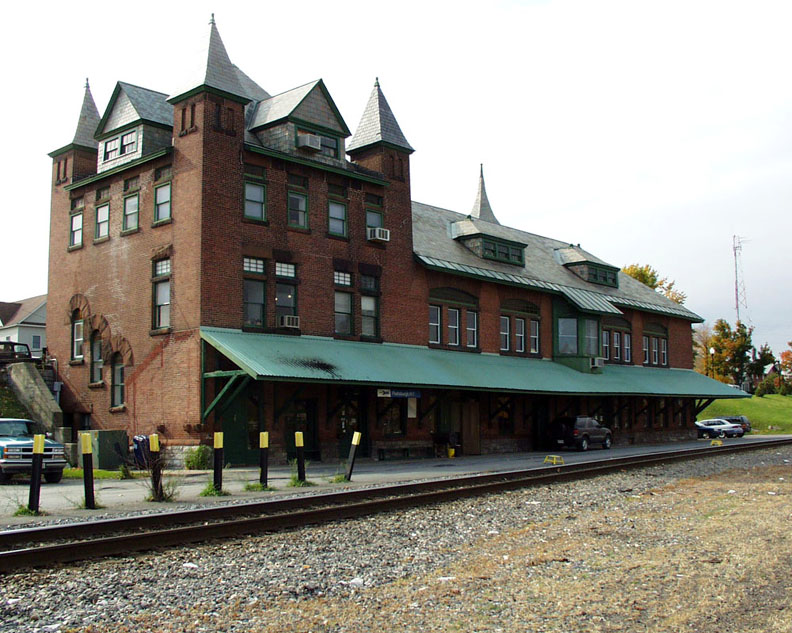
On my birthday, Claire rode up to join me, taking the Amtrak train to Plattsburgh, New York. As I met her at the classic, Victorian rail station, I was surprised at how few people got off the train – no more than 4 or 5 individuals. This is no out-of-the-way spur, I thought to myself. It’s the Amtrak main line between New York and Montreal. Claire’s was the only train of the day connecting those two major cities, and it was more than two hours late (equipment problems). It reminded me of how we’ve let our nation’s once-mighty passenger rail system slip into near-oblivion.
So, if you want to know how I spent my 50th birthday, at least part of the time I was waiting for a train. I have to admit that was better than the earlier part of the afternoon, though, which I spent in a dentist’s chair. I’d lost a temporary crown the evening before, and was fortunate, indeed, to find a wonderful dentist, Dr. Michael O’Connor, who agreed to open up his Plattsburgh office on a Saturday morning, even though I’m not one of his patients.
The irony of that experience wasn’t lost on me. It was my fiftieth birthday, and my teeth were falling out. Literally. Tempus fugit.
It was good to see Claire, though. After driving back to our little house, we went out for a nice birthday dinner at one of our favorite restaurants, overlooking the rushing rapids of the AuSable River. The next day we enjoyed some quiet times, watching the snowflakes swirl (thankfully, they didn’t stick; it was still a little too warm for that). At one point, we were treated to the rare sight of a doe and a faun, foraging for food just outside our window.
How do I feel about turning 50? To be perfectly honest, it seems kind of anti-climactic. The sturm und drang of my cancer experience overshadows any piddling anxiety I might otherwise have felt, concerning this milestone birthday.
I’m not upset about turning 50. In fact, I’m glad I’ve made it this far. I was thankful for a quiet day, in one of my favorite spots, with my best girl by my side.
Claire and I are talking about throwing a bigger 50th birthday party, for both of us (she passed that milestone herself, in July). That party will do double duty as a belated end-of-chemo celebration for me, and also to commemorate Claire’s 15th anniversary of ordination as a minister. We’ll probably plan that celebration sometime later this month, if we can find a date that works.
Milestone birthdays are significant events, for most people – but maybe less so, for cancer survivors. For us, any healthy day is a good day.