Sunday, February 12, 2006

February 12, 2006 - Whiteout


(Point Pleasant Presbyterian Church this morning, from the front porch of the Manse)

This morning the blizzard conditions continue. It seems that today there are other reasons to miss church besides chemotherapy!

Early this morning I’m on the phone to Robin, and – after consulting the latest weather predictions – we make the decision to cancel worship services. We decide who’s going to call which staff member, and we do so. When I call Donna, our church school coordinator, I learn from her husband Bob that their home is without electricity (we’re hoping for their sake the outage won’t last long, because the only other heat they have is from a couple of gas heaters). Claire bundles up and slogs across the snowy street in the dark, to record an announcement on the church answering machine that everything’s been cancelled.

Nothing to do now but wait. The heavy snowfall continues, and is likely to keep up through the afternoon.

I’ve been thinking lately about what a slow process cancer treatment is, and how so much of my life is in a sort of holding pattern right now. The most important dates on my calendar are not classes, meetings or counseling appointments, but medical treatments. I show up for those things with as much diligence and punctuality – if not more – as any other appointment I’ve ever kept.

This morning I swallow my last five, bitter-tasting prednisone tablets, mindfully downing each one with a huge gulp of water so as not to gag. OK, that’s over with, I tell myself. The dregs of chemo treatment #2.

It’s like one of those board games we used to play as children. You move your counter around a sort of winding, circular track, space by space, eventually hoping to break through to the place in the center where you’re home free. In the Chemotherapy Game, though, there are no dice to roll. You don’t dash ahead in irregular spurts – two spaces one turn, six spaces the next. In this game, your counter must pause on each and every square. On the morning and evening of each day, as you arrive at and depart from each space, there are pills to swallow.

There are twenty-one spaces on this game board, one for each day of the three-week chemo cycle. Chemo Day is Space #1. The next four spaces are Prednisone Days (still part of the chemo cocktail, just more spread-out over time than the other drugs). Besides being a Prednisone Day, Space #3 is also a Neulasta shot. Spaces #8, 15 and 21 are blood tests. Certain spaces towards the beginning are colored sickly green for nausea, while the five or six in the home stretch are white for normal. Space #5 is bright orange and decorated with flames: the Prednisone Rush (that’s today; I’ll see if the last cycle’s history repeats itself). Eventually you reach Space #21, passing “Go” and starting the cycle all over again. As I’ve rounded the starting point and begun my second go-round, I’m learning there’s a certain degree of predictability to this game.

Occasionally the game rules require you to draw a card that could introduce a new and unexpected element: a low blood count, perhaps, or an infection, or some other problem. These could influence the way the game goes – whether new medications are introduced, or even whether the chemo dosage or treatment schedule must be altered.

The most important card – even better than “Get Out of Jail Free” from Monopoly – is the “Favorable CT Scan” card. I’ll try my hand at drawing this card just after going round the board three times, and again after the sixth time. In the Chemo Game, you can’t break through to the goal of the game – the “Remission” space at the center of the board – without holding this card in your hand.

For now, though, I’m doggedly circling the board, one space at a time. It’s not a very amusing game, but it sure does hold my attention. Even on a snowy day.

Saturday, February 11, 2006

February 11, 2006 - In the Lee of the Storm


Today’s not such a good day. All the symptoms of post-chemo malaise are here: exhaustion, queasiness, headache, restlessness, lack of appetite. Yesterday, I could feel the downward slide beginning. Today, it’s here in earnest.
A day or so before this point in the last chemo cycle, I had decided to bow out of that coming Sunday’s service. I’d hoped to have the energy to help lead worship that day, and even to preach, but it was not to be. Claire took over for me on that occasion – and by all accounts did a fine job.

This time, I’m under no illusions about my ability to function. Robin’s slated to preach – although, as it turns out, there are other circumstances that could put Claire in the pulpit again.

The reason is a heavy snowstorm – a Nor’easter – that’s already making its arrival. Right now, it’s still just raining outside, but before long the temperature will drop, and we may have as many as 12 inches of the white stuff. If our typical seacoast weather patterns prevail, we’ll probably get considerably less than areas further inland, but right now it’s impossible to say.

I offer Robin the use of a guest room here at the manse, but – as a veteran of the infamous lake-effect snows of Buffalo, New York – she declines, confident she can make it in on her own, as long as the roads have been plowed. If we do experience the worst-case scenario, and the snowplows haven’t made it to her street, then the backup plan is for Claire to walk across the street to the church sanctuary, and lead informal worship for anyone adventurous enough to challenge the drifts.

During my fifteen years here as pastor, we’ve only had to cancel Sunday services once – and that was during a howling blizzard so severe that the New Jersey Governor had ordered all cars to stay off the roads. Even in the worst weather, we generally unlock the doors and see who comes. If it’s just a handful, we become a country church for the day. There’s a wonderful sense of spontaneity and informality at worship on heavy snow days: we’re happy to see those who do trudge through the drifts or pull up in four-wheel-drive vehicles – although we fully understand why others can’t, due to risky travel conditions. Certainly, we’d never want anyone to take any undue risks.

Yet for me, there will be no such party atmosphere. I’m already snowed in, by the effects of the chemo. There's nothing for me to do but wait it out, and trust others to do what I would ordinarily do myself...

Thursday, February 09, 2006

February 9, 2006 - Someone's Watching Over Me

This morning I receive a phone call from Kay, one of the oncology nurses, advising me that the potassium level in my blood is a bit on the low side – I’m at 3.4 and the low end of normal is 3.5. A depressed potassium level is a common side effect of the sort of chemotherapy I’m receiving.

The solution? Eat more bananas and drink more orange juice. There are dietary supplements they can give me, too, but with my numbers not all that far out of whack, they think they can get things back into balance with some minor dietary changes.

This is just another reminder to me of how numbers-driven modern medicine is. My grandfather, Robert Abbe MacKenzie, was a pioneer obstetrician-gynecologist in Asbury Park, New Jersey, and delivered tens of thousands of babies in his time. He used to tell us how, while attending medical school at New York’s Columbia College of Physicians and Surgeons around 1917-1921, he learned how to make mustard plasters. He also learned how to diagnose the position of a baby in its mother’s womb by touch – nowadays most obstetricians wouldn’t know how to do that, because they depend on ultrasound scans. By the time my grandfather was 100 years old and receiving medical treatment himself, there must surely have been a lot that was mysterious to him about how his own doctor made treatment decisions.

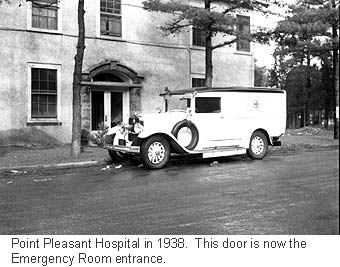
I also remember hearing Arnie Lane, a longtime member of our church who was chief administrator of the old Point Pleasant Hospital for decades and lived into his mid-90s, tell of how he began his career in hospital administration. He was hired by a local doctor at the age of 18, while he was still in high school, to administer anesthesia during surgery. There wasn’t much more to it than squeezing a rubber bulb as the doctor instructed him, inflating the patient’s lungs with an air-and-ether mixture and maybe keeping his eye on a gauge or two. When the surgery was over, it was Arnie’s job to go out into the streets of Point Pleasant Beach with a couple of dollars, and hire four strong men to come carry the patient upstairs, from the former dining room of the converted house the doctor used as a hospital, into one of the upstairs bedrooms. It just goes to show how much medicine has changed in just over one human lifetime.

(Actually, even the caption's now a historical artifact; the hospital building was sold and torn down recently.)

As for me, I’m glad someone’s been scrutinizing my blood-test results in order to let me know when my potassium’s down. It’s comforting to know that some perfect stranger is watching over me in that way. It’s also a little creepy: that something so intimately personal as my own blood chemistry is displayed on the computer monitor of some lab technician I’ve never met.

So, I eat a banana this afternoon. Maybe I’ll have a glass of V-8 or orange juice before I go to bed tonight. I’ve got to keep covenant with those kind people who are watching over me.

I’ll bet some of you thought, when you read the title of today’s entry, that it would be all about how God watches over us. Well, it is. I believe God uses all kinds of people, sometimes in ways we don’t even know, to insure that “all things work together for good for those who love God, who are called according to his purpose” (Romans 8:28). I like to think that God’s purpose is for me to survive this thing, to continue my ministry, to continue to be here as a husband and father and friend. If it’s not, well, that’s not what I want – but the promise of faith is that even that, too, would somehow be an example of everything “working together for good,” in ways I can scarcely understand. Someone, indeed, is watching over me.

February 8, 2006 - Chemo 2


Claire and I arrive at Dr. Lerner’s office at 9:30 a.m. for my second chemo treatment. She sits in on my discussion with the doctor, then leaves me in the chemo nurses’ capable hands for the rest of the day.

The nurses have some difficulty getting the IV needle into my porta-cath, because it’s deeper under the skin than most people’s. After an abortive attempt, they have to try again with a “large needle.” (I’ll have to remember to ask for that next time, so as not to have to go through this trial-and-error process again.) Even so, the pain is about as bad as a hypodermic injection - worse than my routine blood tests (for which they use such a fine needle I can hardly feel it), but still very manageable.

Early in my treatment, I have a wonderful, unexpected visit from Don, our friend who's an NHL survivor and who received his chemo treatments from the same medical group. He stays for 15 minutes or so, and it does help to make the time go faster.

Once the drugs start flowing, I immediately start to feel drowsy. They tell me the intravenous Benadryl is responsible for that. It’s the familiar over-the-counter antihistamine, but in a massive dose – this to minimize the body’s reaction to the Rituxan. I set out some books on the table by the lounge chair, but never open them. Once the Benadryl starts flowing, the drowsiness makes it too hard to concentrate. Instead, I watch TV.

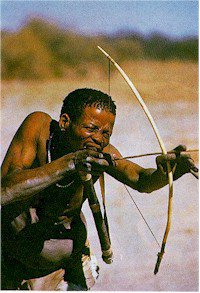
After my first experience three weeks ago, I learned that each of the TVs in the little private rooms they use for chemo infusions has a built-in VCR. So, I’ve come prepared this time with a couple of videos. One of the films I watch is an old favorite of ours, a little South African film called The Gods Must Be Crazy. It’s a wacky and touching comedy about a Bushman (aborigine) from the Kalahari Desert in Africa, who happens to see a Coke bottle fall from the sky, dropped by the pilot of a passing airplane. He doesn’t know where it came from, so when he sees it plop down in the sand near his feet, he assumes it’s a gift from the gods. These people are so remote – subsistence hunter-gatherers – that they have no idea what this thing is. They find it a useful tool for all sorts of purposes. Eventually, the man who found it realizes that the members of their little band are fighting over the Coke bottle so much that he concludes it must be evil. He resolves to go on a long journey to drop it off the edge of the earth, so the gods can have the pesky thing back.

On the way, he encounters civilization, which for him is not a good thing. Through a series of misadventures, he ends up under the care of a rather inept, Crocodile Dundee-type biologist and his native sidekick, and is able to offer his superior stalking and tracking skills to help them rescue some schoolchildren who’ve been kidnapped by some revolutionary guerrilla fighters. There’s a subplot about the shy biologist having a crush on the children’s schoolteacher, and the bushman is able to help with that situation, too. He walks off, at the end, to return to his people. The last we see of him, the cash reward money he has earned is blowing away in the wind - for of what use are these little scraps of paper in his world?

Anyway, it was an interesting experience watching this film, while hooked up to machinery to receive some of the highest of high-tech medicines. Western medicine is certainly effective, but it’s fantastically expensive. I’m grateful to have medical insurance to pick up at least some of the cost. There are still people in the world who live off the land, as the Kalahari bushmen do, and undoubtedly have their own disease remedies. I wonder if cancer is even an issue, in their world?

Claire stops by again around 5:00, and sits with me until I’ve received the last drop. We return home, and I pick at the delicious meat loaf dinner one of our church members brought. I sit on the couch for a while as the now-familiar queasiness and headache intensify, before going to bed.

Tuesday, February 07, 2006

February 7, 2006 - Dreamscape of Doom


One thing I've noticed in recent weeks is that I seem to be having more vivid dreams – or, perhaps I've just been able to remember my dreams better. Claire has told me on numerous occasions that she thinks it odd that I rarely remember my dreams. Unlike me, she has a very vivid dream life, and likes to tell me and others about what she's been experiencing in that liminal, meaning-laden place that is the zone of overlap between sleeping and waking.

This morning I awake with a start at about 6:00 a.m. I've been having an especially vivid nightmare. Somehow it's happened, in my dream, that I've witnessed some kind of crime, and the law-enforcement authorities are calling on me to come testify in court. I become aware that some gangsters know I'm going to testify, and are trying to murder me. I'm taking elaborate precautions to make sure the gangsters won't find me. I have several close calls, escaping them in the nick of time.

Because they know what my car looks like, the police have advised me to rent a car, so the gangsters can't follow me as I drive to the courthouse. I find myself at an odd sort of car-rental place that's actually more like a run-down farm. The car-rental people recommend that I rent an old classic car, a 1930s-era roadster that looks as much like an old-fashioned racing car as anything else. It's parked way out back behind the rental office, in a place overgrown with tall grass.

They send me out back with the keys, and I climb into the driver's seat. I realize, then, that the car hasn't been driven in some time, and there's a closed wooden gate immediately in front of it. I get out and fumble with the numerous, rusty latches that secure this weatherbeaten old gate. I still don't have them all open when I look back over my shoulder and realize there's another old 1930s-era car behind me and to the left, a black sedan.

It's the gangsters – they've evidently been waiting for me. A man and a woman who look sort of like Bonnie and Clyde are sitting in the front seat, and there several others in the back. Their car is slowly, silently inching toward me, through the tall grass. In a moment they'll be alongside me. I'm too far from the rental office to call out for help, and my fingers are still fumbling, in slow motion, with the gate's latches. There's no time now to finish opening the gate, let alone leap back into my car and start it up. It's such an old car, I'm not even sure it would start up. They're going to shoot me, I think to myself, and there's nothing I can do about it!

It's just at that moment that I wake up. Looking around and realizing I'm in my own bedroom, I reassure myself it was only a dream, and feel an immense sense of relief. As I start to drift back to sleep, I'm aware that the dream is still lurking there, unfinished, somewhere in my mind. I feel quite certain that if I allow myself fall back into sleep, the gangsters will get me. Somehow I will myself to stay awake for a few minutes longer, until I feel confident that the last remnants of the dream have dispersed like morning mist.

It's a classic anxiety dream. Tomorrow morning I go for my second of six chemotherapy treatments. I suppose I've been dreading it more than I thought – the exhaustion, the low-level queasiness the anti-nausea drugs can contain but not eliminate, the sense of being on a downward spiral for days, before I slowly start to emerge again. Underneath it all, I suppose, is a fear of death, a fear that the treatments will not shrink the tumors and put me into remission after all.

Somehow the dream has functioned to tell me how I'm really feeling about this, on a subconscious level. It's better, I suppose, to be aware of these feelings than to suppress them. Having this dream is, in some strange way, part of the emotional work of dealing with my disease. Having had it, I can acknowledge to myself that these irrational feelings of dread are there. I can bracket them in my awareness, and place them where they belong. As unpleasant as it was, I feel that the nightmare has taught me something I need to know, something that's hard to put into words.

February 5, 2006 - A Sermon on Samson

The Sunday worship service goes pretty well today. It’s the first time most church members have seen me without my hair or beard. Many people tell me, afterwards, they didn’t recognize me until they heard my voice. The other thing I hear, over and over again, is that without hair or beard, I look "ten years younger." ( I wonder... does that mean I was looking like I was 59 and now am back to looking my age – or does it mean I did look my age, and now I’m a spry 39-year old?)

When I go back to the choir room to lead the choir in a pre-worship prayer, as I often do, Bill, our choir director, gives me one of his typical greetings. Bill’s proud of his German heritage, and often throws German words and phrases around in a jocular manner. It’s part of what he would call his "schtick." This time he hails me by saying, "Greetings, Mein Herr" – but then he realizes what that sounds like in English (mine hair), and he and the choir crack up. It’s good to know we can laugh about all this.

Just for the fun of it, I’ve decided to depart from the lectionary (the list of recommended scripture passages for each Sunday) and preach on the story of Samson. I figured the congregation would all be staring at me and thinking about my hair loss, anyway, so I might as well get some homiletical mileage out of it.

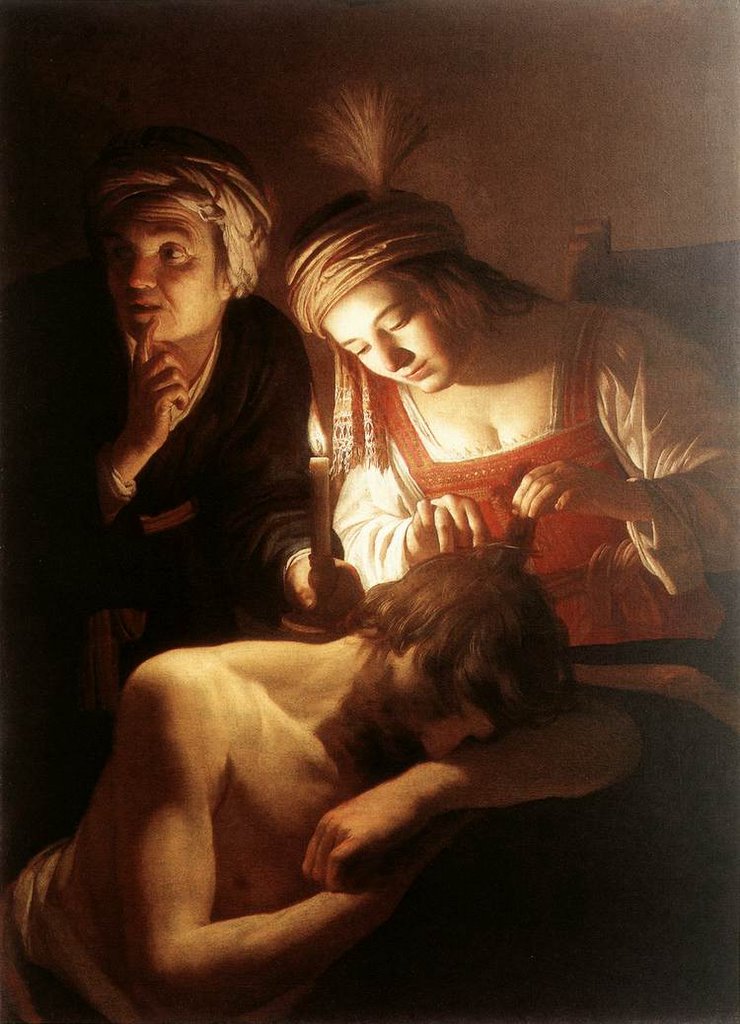
Many people think they know the story of Samson, but the only thing most really know about this biblical strongman is the way Delilah cuts his hair while he sleeps, then hands him over to the Philistines in a weakened condition. Yet there’s a good deal more to the story than that – and, when we look at the tale in its entirety, it turns out Samson is anything but a positive role-model. That’s probably the reason the lectionary editors decided to omit his story from their list – as much as the fifth-grade Sunday School boys may enjoy all the murder and mayhem, Samson does a lot of things that would make Dana Carvey’s "Church Lady" blanch – not the least of which is spending a night in a "house of ill repute" (check it out if you don’t believe me: Judges 16:1).

Preaching on this story is a challenge. It’s a bit of a puzzle why, in the Bible, God continues to back this prideful, hot-tempered, violent character, who seems as much interested in brawling and chasing women as he is in practicing holiness. I understand there are a few Christian motorcycle clubs out there – groups of people who dress and talk like the Hell’s Angels, but who are actually very sincere about witnessing to their faith. I expect ol’ Samson would fit right in with that crowd.

I present his story as a tall tale – and Samson as sort of like a biblical version of a comic-book hero. He’s a larger-than-life figure, to be sure – although what’s truly larger-than-life about his story is God’s dogged determination to stick to the terms of the covenant, no matter how undeserving its current human representative may happen to be.

It’s just another example of how the Bible speaks to us from a very different culture, and how the only way to truly understand its meaning is to somehow get inside that foreign culture.

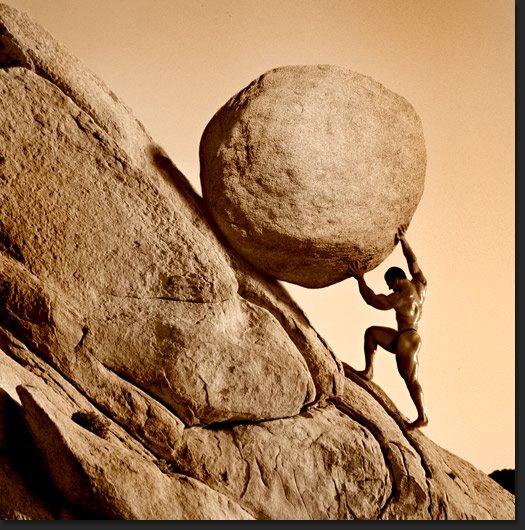
I feel pretty much back to normal now – just in time for my chemo treatment on Wednesday, which will send me back to square one. There’s something Sisyphean about the cycles of chemotherapy: with great labor we cancer survivors push the stone up to the top of the hill, only to see it roll back down again. We can only trust that there’s progress, silently going on deep inside us as the tumors shrink and wholeness is gradually restored.

Saturday, February 04, 2006

February 4, 2006 - Mistaken Identity


I haven’t exactly been out and about much in the last day or so – mostly I’ve been hunkered down at home, making phone calls, catching up on various things and working on tomorrow’s sermon – but I’ve had a few interesting reactions from people who have seen my new look.

Our Thursday-morning staff meeting was relocated to a more open area, because one of our Presbyterian Women circles was using the room we usually meet in. That meant several of the circle members walked by our little group on their way to their meeting. I said hello to a few of the women as they passed by, and got some mild “double-take” responses. One woman had little reaction of any kind. I supposed she hadn’t heard me, so I thought nothing of it. Yesterday I received an e-mail from her daughter, who had been speaking with her mother on the phone. She wanted to be sure I knew that her mother – who has vision problems – had no idea who I was. After hearing her friends talk about how different I look, she made the connection, and immediately worried that I might have concluded she’d been ignoring me. I wrote back immediately. Please assure your mother I understand completely: I look so different, even people with normal vision are having problems identifying me!

Yesterday I ran into another church member in the hallway, and nodded hello. She nodded back – but then, as I said something, I could see the look of recognition appear in her face. She took a good, long look at me, then said, “Oh! It’s you!” She apologized for not having recognized me. Not to worry, said I. I’m getting that a lot, these days.

Some friends and family members – both those who have seen me in person, and those who have viewed the “before and after” photos online – have remarked on how young I look with no hair or beard. I find that hard to believe, for some reason. I associate baldness with aging, so “younger” is not exactly the word I would choose – though maybe a beard has an aging effect as well, so losing it makes me appear younger. It’s hard to say. I’ve had my beard for so long, it’s become part of my self-image. It’s a bit disconcerting, after all that time, to look in the mirror and see a virtual stranger looking back!

Going through some cards in my wallet, I glance at my driver’s license. I wonder what’s going to happen, should I need to show I.D. during this chemotherapy season. I don’t suppose most chemo patients, losing the hair on their heads, have a huge problem with identification – though when the beard is added to (or, rather, subtracted from) the equation, it’s a near-total change. If I should have cause to board a plane before my hair grows back, will I be pulled aside for interrogation as a Homeland Security threat?

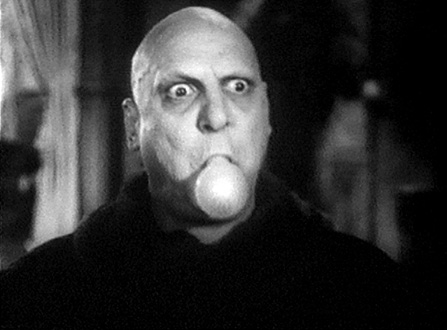
Tomorrow’s Sunday. I’ll be leading worship for the first time with no hair. A part of me is wondering if, after donning my pulpit robe, I’ll look a little like Uncle Fester on the old Addams Family TV show. Oh, well. We’ll see what tomorrow brings. Maybe I should stick a light bulb in my mouth...

Thursday, February 02, 2006

February 2, 2006 - My New Look

This morning I wake up and look at myself in the bathroom mirror. I'm feeling good enough to go to our church's weekly Men's Breakfast at the OB Diner, but the question is: will my beard go with me?

I pull gently on the beard. A few of the hairs come out. That's it, I say to myself, reaching for the new electric razor Claire just bought me (I've been instructed to avoid conventional razors, in case my blood platelet level dips, leaving me at risk for bleeding). The electric razor has a sideburn-trimmer attachment, and I use that to buzz off my beard and moustache – much as Jim the barber did with my head hair yesterday. The fine shaving with the electric razor that follows isn't as painful as I thought it might be. When it's over, I run my fingers over a chin that hasn't been clean-shaven for 23 years. (I'm a creature of habit, what can I say?)

A little later I drive over to the diner, and take my place at our usual table. The dozen or so men who go to this breakfast, most of them retired, sit in exactly the same seats every week. (I guess they're creatures of habit, too.) The way to really rile this group up is to sit in a different place. Apparently they've never considered this seating arrangement's chilling effect on newcomers, but then they haven't had a newcomer in a long while, so I don't suppose it much matters. I consider taking a different seat myself – to go with my new look – but then think better of it. I sit down in my accustomed place, and introduce myself as the new pastor. That breaks the ice a bit. I find it good to be there. Some of these men have faced some major health problems themselves, so they're very supportive. Besides, it just feels good to be out, after all those days spent in the house.

Today is Groundhog Day. They say Punxsutawney Phil, the famous weather-predicting rodent, waddled out of his burrow this morning and saw his shadow – meaning six more weeks of winter.

When it comes right down to it, of course, Phil is more of an entertainer than he is a meteorologist. Every February 2nd he's good for a newspaper headline or two. Yet there's a part of us that continues to be fascinated with this furry beast's legendary ability to predict the future.

What if we could know for sure what the next six weeks are going to be like? How would we live our lives differently, if we did know?

One strange thing about a chemotherapy regimen is that it allows patients to know more than most people do about what their immediate future's going to be like. This morning I sit down with the church staff for our weekly meeting. As usual, we all get out our calendars and PDAs. Every third Wednesday in my Palm Treo PDA's calendar is now blocked out for each of my upcoming chemo treatments. More than that, I now know that – based on my first treatment experience – I'd better not plan anything for the 5 or 6 days immediately following Chemo Day. As for the next week or so after that, it's sort of a gray area. The third week, I should be home free.

It's an odd feeling, to look ahead on the calendar and plot out the days when I'm going to be sick. But that's what the artificially-induced sickness of chemotherapy allows you to do.

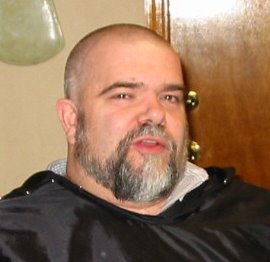
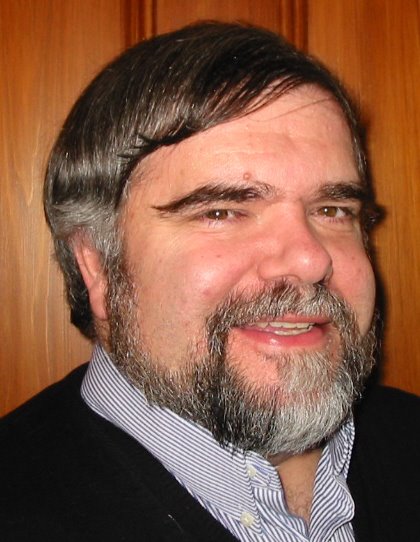
Back home in the early afternoon, I greet Ania and Cory as they come home from school. Both are very interested indeed to see what I really look like under that beard. I prevail upon Ania to take a few photos.

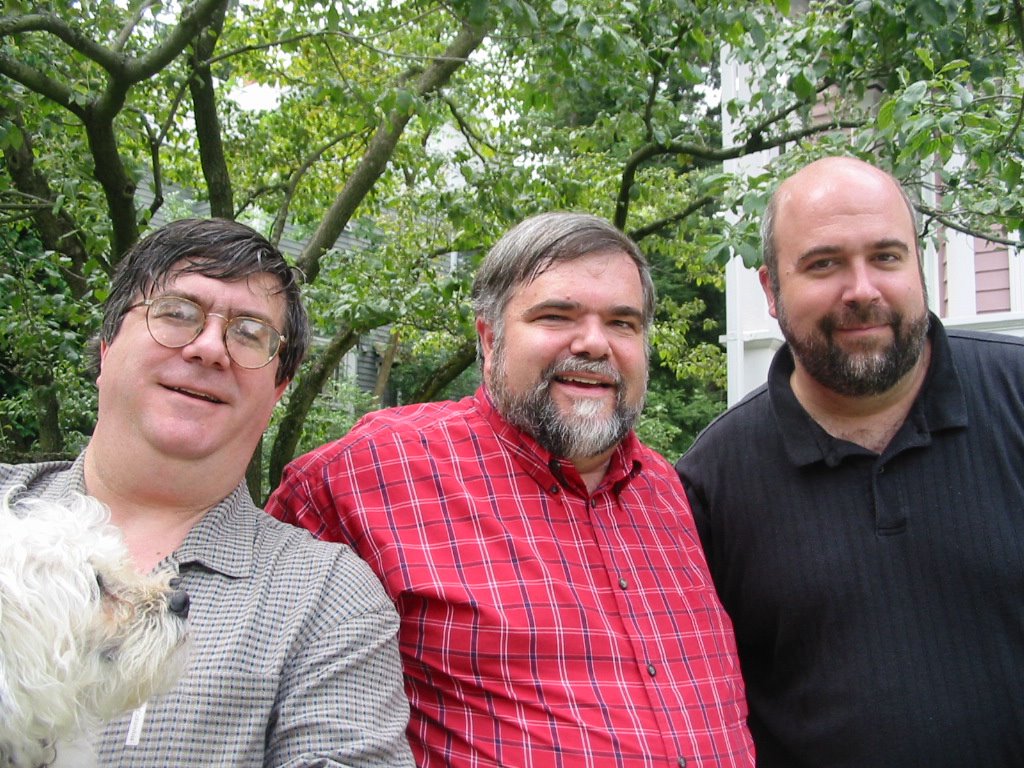
Studying the contours of my face, Ania's especially interested to see something of my brothers Jim and Dave. I've always thought I look more like Dave than Jim, but – now that the beard is gone – I can definitely see some hints of Jim as well, especially around the mouth and jaw. Genes will out, as they say...


(left to right - Jim, Carl, Dave - August, 2005)


Wednesday, February 01, 2006

February 1, 2006 - Tonsured


This morning I go for my weekly blood test at Dr. Lerner’s office. I’m in and out in about 15 minutes. The CBC (complete blood count) comes back normal – except for that fact that my platelets are a little low.

Is this a problem, I ask Diane, the oncology nurse? No, she says. Your platelets are just slightly below normal range. Nothing to worry about.

About 3:00 this afternoon, I make my decision: Today is the day. All day I’ve been feeling the same odd sensation I had yesterday: that my hair seems drier and more brittle than usual. I reach up and gently pull on a hank of hair. Three or four of the hairs I’m holding come out in my hand. I do it again... and again... and again. Same result.

Yup. It’s starting. The prospect of waiting around for my hair to start falling out in clumps doesn’t seem at all appealing. I call Jim, the guy who cuts my hair. He’s got an opening in his schedule. Come right over, he says, cheerfully.

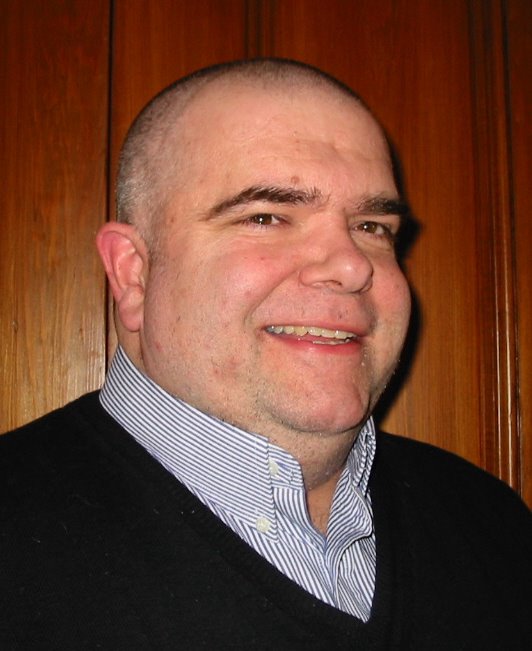
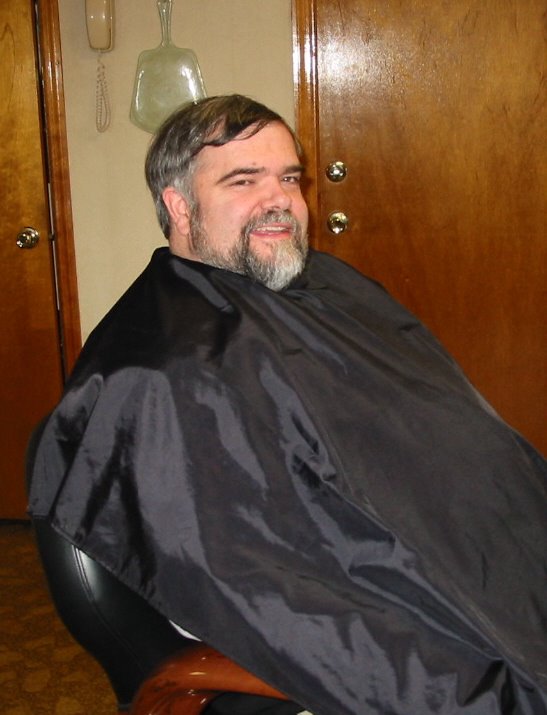
So I do. I bring my digital camera along, to record this event for posterity – “before and after” shots. I understand that, after chemo, hair can come back in differently, and Jim confirms this, from his experience as a barber. People who once had straight hair can find themselves sporting curls. People who once were mostly gray may have new hair that’s much darker – or vice versa. I’ve had kind of a salt-and-pepper gray in recent years, so I figure anything’s possible. (All the more reason to get that “before” photo.) Jim’s a good sport about taking a few snaps.

He tells me it will all be over very quickly, and it is. The first pass of the electric razor is a little nerve-wracking – it seems so irreversible. After that it’s merely interesting, to watch the hanks of hair fall off the newly-exposed dome of my skull. In no time at all, my head’s covered with nothing but peach fuzz.

Jim takes my “after” photo for me. I thank him and tell him it will probably be a while before I see him again – maybe not till July or August. Then, it’s back home again.

I’ve warned everyone what’s coming, so nobody seems too shocked as they come in the door and find this strange, baldheaded person in the house. Claire, Ania, our nephew Cory and niece Elizabeth all want to run their hands over my head, to feel the fine hair. Everyone remarks on how much I look like my brother Dave all of a sudden (Dave’s my youngest brother, who’s got a bit more experience with this hair-loss thing than I have).

I reach for my beard and try the same pull-out-a-few hairs test I used for the top of my head. Nothing. Try again - nothing. Try a third time - well, look at that: there are a few hairs between my fingers. Try another time - a few more hairs come out. It’s not going to be long for the beard, either. I decide to wait till tomorrow before I do anything more radical.

The beard’s a bit more difficult in some ways. I’ve had it since I was a college student. Having no hair on the top of my head is an adjustment, but having no beard may render me all but unrecognizable to some. Such as my kids: they’ve never known me without it.

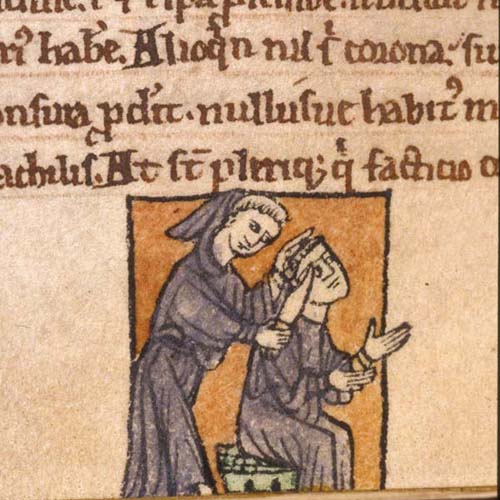
Two years ago, Claire, Ania and I had a sabbatical trip to Ireland and Scotland, to study the roots of Celtic Christianity, which was heavily influenced by monasticism. I learned, then, about the tradition of tonsure – the way the monks would shave their heads, as a symbol of obedience to God and membership in the monastic order.

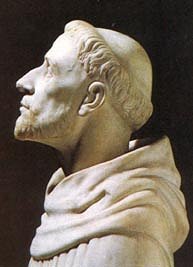
When most people think of a monk’s tonsure, they think of the Roman tonsure: the very top of the head shaved, with a sort of ring of hair remaining, just above the ears. It’s the classic Friar Tuck haircut from the Robin Hood movies.

The Celtic monks of Ireland, Scotland, North England and Wales had an entirely different tradition. The Celtic tonsure included the shaving of the front of the head only, with the hair in the back allowed to grow long.

Today I’ve been initiated into the Order of Chemotherapy. The tonsure of this Order is a good bit more complete than the others: when everything is said and done, there’s no hair remaining. Now I’m marked as a member of this exclusive society – set apart for all the world to see. No one applies for admission to this Order, but some are called to it all the same. Once one becomes a novitiate, there’s no backing out.

Tuesday, January 31, 2006

January 31, 2006 - Hair


It’s a gray, rainy day today, and I’m thinking about something I usually don’t spend much time thinking about: my hair.

For the past several days, I’ve been on the alert for signs that the predicted, chemotherapy-induced hair loss may be starting. Still no hairs on the pillow or in the bathtub drain this morning – but as I’m toweling off after my shower, my hair feels different. The only way I can describe it is to say it feels like I’ve been swimming in a pool with way too much chlorine. It feels kind of stiff and dry, and my scalp itches.

Maybe it’s just a bad hair day... but somehow, I don’t think so.

A little later, I seriously consider going to the barber shop for the buzz-cut I’ve planned to get, but decide to wait till tomorrow. Or maybe the next day...

Like many guys, I’ve never considered myself to be especially vain about my hair. I’ve had the same basic, low-maintenance hair style for years. If anything, I tend to go a little too long between haircuts – just because I consider fussing with my hair to be a bother.

I’ve never worried too much about baldness, either. I always figured, if it happens, it happens (so far, I’ve been pretty fortunate). But the prospect of losing my hair all at once feels very different. It’s a visible symbol of change.

It means that – especially if I lose my eyebrows as well – everyone I meet will know that I’ve got cancer, and am receiving chemotherapy. I’m not keeping my condition a secret – but on the other hand, I’m not walking around town wearing a sign that says, “Cancer Patient,” either. Will my hair loss change the way strangers deal with me? Will I become not “that guy over there,” but “that poor guy over there with cancer”?

The most famous guy in the Bible who lost his hair was Samson. Samson was a nazirite – a sort of wild and woolly holy man (literally!). The chief distinguishing feature of nazirites was that they never cut their hair (Judges 13:5).

Samson’s long hair is a symbol of his devotion to God, and also the source of his power. While most film and literary treatments of Samson have portrayed the hair-and-power connection as something magical, the biblical writers probably saw it more as symbolic of the strength of his spiritual life. As long as Samson keeps his austere, ascetic ways, the Lord is with him; but once he adopts the settled ways of townsfolk and comes to enjoy his creature comforts a little too much, he ceases to be able to perform those feats of prodigious strength – like catching three hundred foxes and tying their tails together (Judges 15:4), or slaying a thousand warriors with the jawbone of a donkey (15:15). It’s pretty colorful stuff – not to mention grisly, at times – but this is a sort of Paul Bunyanesque tall tale, so I think we can forgive the storytellers a little poetic license.

When Samson gets mad, he’s kind of like the Incredible Hulk (except for the green skin thing, which the Bible never mentions). It’s not gamma rays that make Samson so powerful; it’s the fact – as he reveals to his lover Delilah (a Philistine sympathizer) – that “a razor has never come upon my head” (16:17). Delilah gets out the razor while he’s sleeping, and that’s the end of ol’ Sam’s super-strength.

At least for a while. As he’s languishing in prison, Samson’s hair starts to grow back. In the climactic final scene, he pulls down the stone pillars of the Philistines’ banqueting hall, killing more people in that one act than he’d killed in his entire life. He also sacrifices his own life, buried in the rubble.

It just goes to show how powerful a symbol hair is. For most of us, it’s part of our self-image, our sense of who we are. I suppose what bothers me most about losing it is the subconscious fear that my cancer is going to change me, on some fundamental level – that it will somehow take away my personhood. It won’t, of course – but, like many others who’ve got this disease, I’m going to have to work on seeing myself as a person with cancer, rather than a victim of it.

Monday, January 30, 2006

January 30, 2006 - Excavating the Bills


Cancer treatment brings many stresses, many of which I've written about in this journal. One stress I haven't mentioned yet is dealing with the bills.

Over the past several months, I haven't been paying very close attention to the bills that have been arriving. I've let them pile up. Presbyterian ministers like myself have pretty good medical insurance – Blue Cross/Blue Shield coverage provided through our denomination's Board of Pensions. So, I know the first step is letting the insurance pay on these. That takes a number of weeks.

For each bill, there's a corresponding mailing from Blue Cross/Blue Shield – the Explanation of Benefits (EOB). This explains the detailed rationale behind the insurance company's decision of what to fund, and how much. Usually the insurance company negotiates a special rate with the doctor, hospital or lab – so, the revised bills indicate an adjusted starting figure, from which the insurance payment is then subtracted, leaving a new "bottom line." The original amount billed has little relation to reality: it's complete and utter fiction. This means the only appropriate thing to do with a new medical bill is to ignore it for a while.

Each doctor, hospital or lab has a slightly different way of accounting for expenses – so, while the EOB forms are pretty standard, comparing them to the medical bills is a challenge. Those bills are infamous for fuzzy, imprecise language, arcane abbreviations and numerical codes for which no explanatory key is provided.

I don't know how this strikes other people, but to me this is an absolutely crazy system. The amount of time, money and energy spent in this country on medical financial record-keeping can probably never be measured. One estimate I heard is that forty cents of every medical dollar spent in the U.S.A. goes to record-keeping. That same estimate included figures for Canada, which has a national health-care system: it's supposedly five cents on every dollar up there.

Unlike many Americans, I've actually been a participant in a so-called "socialized medicine" system. During two different years when I studied in Britain (at Oxford and St. Andrews), I was covered under National Health. While, as a young and healthy university student, I didn't have too much need for health-care services, I did have some experience with British medical providers – and it was all very favorable. One thing I can say: Scotland is the only place I've ever had a house call from a doctor.

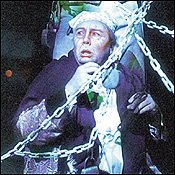
I know, from conversations with nurses and other health-care professionals, that they all feel snowed under with paperwork. Patient care suffers, as a result. Once, America had the finest health-care system in the world. We're still up there in terms of quality, but I think we've lost our pre-eminent place. The thing that's pushed us out of first place is the health-care funding mess. Doctors today are disturbingly like the pathetic figure of Marley's Ghost in Dickens' A Christmas Carol: they're shackled with the chains and money-boxes of all the armies of accountants they have to deal with.

There's a certain cost to patients as well. There's a legitimate concern about all the time doctors and nurses must spend on accounting paperwork, but nobody seems to want to talk about the untold hours that patients and their families must spend puzzling out their medical bills. I know that, in the next few weeks, I need to attack that small mountain of bills. I'm hoping the window between now and my next chemo treatment lasts long enough for me to make some progress on this. Somehow, I've got to sort out which bill matches up with which EOB, check them both over for errors, and begin to make payments.

Is it therapeutic to have to do this when you're sick? Hardly. But what choice is there? It's not only the doctors who are all wrapped up in chains like Marley's Ghost. The patients are, too.

Friday, January 27, 2006

January 27, 2006 - Caring and Curing


I'm thinking today about two words: "care" and "cure."

Only one letter separates them. But they're closely related in other ways.

Not long ago – using a gift certificate the church had given me, in celebration of my 15 years here as pastor – I bought a book I've always wanted: The Shorter Oxford English Dictionary. ("Shorter" is a relative term when it comes to this dictionary's two very thick volumes, but it's still a far cry from the 16-volume complete OED.) I've long wanted to own this treasure trove of information about word origins.

Word origins are a hobby – some would say an obsession – of my brother Dave, who's got his own website devoted to this subject, and has even published a book, Word Myths, on "linguistic urban legends." So I'm aware that what I'm going to say here about "care" and "cure" is strictly an amateur effort, compared to the sort of thing he does.

My Shorter OED tells me the word "cure" is derived from the Latin cura, which means "care for." We can also see that old Latin word pop up in the word "curate" (a priest who cares for the needs of a parish), and in "curator" (someone who guards and oversees a museum's collections).

Yet the modern word "cure" means more than just looking after someone's needs. It means bringing about a change in the person, from sickness to wellness. That meaning is similar, I suppose, to another sense of the word "cure": creating a chemical change in something in order to preserve it – as when a tanner "cures" a piece of leather, or a farmer "cures" a ham by smoking it.

And what of our English word, "care"? The origins of that word are completely different. "Care" doesn't come from the Latin at all, but rather from the Germanic family of languages. The Saxon or Old Norse root of "care" is a word describing a wail of sorrow or grief. Think not so much of a nurse calmly spooning medicine into the mouth of a bedridden patient, but rather of some horned-helmeted Viking, roaring in grief at the sight of a fallen comrade. To care, in the oldest sense of the word, is to have your emotional equilibrium shattered.

Yet these two similar-sounding words, different as they are in their origins, are still linked together in some remarkable ways. How are patients ever cured of their illnesses unless someone also cares for them in the emotional sense? Sure, scientifically-based medical treatments are vital to healing, but they've got to be seasoned with love if they're to be fully effective.

Rachel Naomi Remen, author of Kitchen Table Wisdom, has something to say about this. She's a medical doctor who for years has specialized in treating the emotional needs of cancer patients. One of her patients, a man named Dieter, had reached the end of the road of his chemotherapy treatments. They were no longer making any difference, medically speaking. As he conferred with his oncologist about the wisdom of stopping treatments, he asked the doctor – whom he liked very much – if he could continue to come in and meet with him, anyway, just to talk. The doctor became visibly uncomfortable. "If you refuse chemotherapy," he explained curtly, "there's nothing more I can do for you." Reluctantly, Dieter elected to continue receiving his weekly injection, for this was the only way he could keep seeing his doctor.

Explaining his decision to a cancer support group sometime later, Dieter lamented, "My doctor's love is as important to me as his chemotherapy, but he doesn't know."

That would be a compelling story in itself, but there's more. Let's let Dr. Remen herself continue it:

"Dieter's statement meant a great deal to me. I had not known, either.... Medicine is as close to love as it is to science, and its relationships matter even at the edge of life itself.

But I had yet another connection to Dieter's story. His oncologist was one of my patients. Week after week, from the depths of chronic depression, this physician would tell me that no one cared about him, he didn't matter to anyone, he was just another white coat in the hospital, a mortgage payment to his wife, a tuition check to his son. No one would notice if he vanished as long as someone was there to make rounds or take out the garbage. So here is Dieter, bringing the same validation, the same healing to his doctor that he brought to me, but his doctor, caught up in a sense of failure because he cannot cure the cancer, cannot receive it."
(Kitchen Table Wisdom; Riverhead, 1996, p. 65)

Caring and curing: they’re intimately related, in ways most of us can only begin to imagine. I feel very fortunate indeed to have a family, a church community and a team of medical practitioners who care for me deeply, even as we work together toward achieving a cure – or, in the case of my NHL, at least a remission.

Thursday, January 26, 2006

January 26, 2006 - Turn, Turn, Turn

Today I’m catching up on some e-mails, and am reading some encouraging words written to me by Anne, a friend from our college days. Anne’s a nurse who has cared for cancer patients, and has even taught nursing to others. She lost both of her own parents to cancer. So she knows the score.

I’ve had so many wonderful contacts, in recent days, from friends like Anne – people with whom Claire and I were once very close, but from whom we’ve drifted away. It’s an inevitable process, I suppose. The years go by, geographic separation takes its toll, children come along and the sheer dailyness of life piles up all around us like mine tailings. Under the cumulative weight of such pressures, it’s all too easy to let significant friendships dwindle into a dormant state.

The news of my illness has been like a gentle breeze blowing across the sputtering flame of some of these neglected relationships. I’ve discovered that the caring and concern we once took so much for granted are still very much present. We can fan the flame. We can pick up where we left off. And that’s been a great source of strength.

I’m realizing that, for many of these friends, I’m the first of their peers to come down with a life-threatening illness. I’m 49 years old: firmly ensconced in mid-life, but still not so old that casual conversations naturally turn to subjects like heart catheterizations and prescription drug plans. People in their forties aren’t supposed to get cancer. Not only does it seem unfair, but in some way it even seems illogical.

I am of the generation that swayed, in blue jeans worn out at the knees, to the words of Ecclesiastes, chapter 3, as sung by the 1960s folk group, the Byrds:

“For everything,
(turn, turn, turn)
there is a season,
(turn, turn, turn)
and a time for every matter under heaven.
A time to be born, a time to die...”


What were we thinking, as we nodded our heads to that lyrical melody on Top 40 radio? Did we have any conception of what those words mean – of how dark and brooding is their theology?

“What gain have the workers from their toil?” implores Qoheleth, “The Teacher” (Ecclesiastes 3:9). He really wants to know. What is life for, he muses, if it can come to an end so capriciously? Overwhelmed by this mystery, seemingly too deep for human understanding, he concludes, “there is nothing better for them than to be happy and enjoy themselves as long as they live; moreover, it is God’s gift that all should eat and drink and take pleasure in all their toil” (12-13). It’s not all that different from the sappy sentiment of that old beer commercial: “You only go around once in life, so you’ve got to grab for all the gusto you can.” The only difference is that, for Qoheleth, God’s the one working the beer tap.

Perhaps Qoheleth’s darkest moment comes in these words: “I said in my heart with regard to human beings that God is testing them to show that they are but animals. For the fate of humans and the fate of animals is the same; as one dies, so dies the other. They all have the same breath, and humans have no advantage over the animals; for all is vanity. All go to one place; all are from the dust, and all turn to dust again” (18-20).

There have been times when I’ve wondered why these gloomy words are in the Bible at all. What is it about the philosophical meanderings of this tortured soul that led the compilers of the Hebrew canon to declare them holy scripture?

Our friend Anne seems for a moment to be on the same page as Qoheleth:

“For me (and I wonder if it is this way for you) the real sticking point is trying to figure it out. The ‘Why?’ As a person of religion and philosophy I’m sure you are well versed at pondering completely unanswerable questions. But now you are at the very center of the question. While our nature is to seek and find meaning in our human experiences and existence, our frustration is most often simply increased as questioning often leads us to even murkier waters.”

But Anne’s got a lot more going for her, faith-wise, than old Qoheleth apparently did:

“It is in the struggle with these questions, however, that the love and support of family and friends, the fellowship of others is most reassuring. If it is not more powerful than the chemicals we have designed to fight disease, it is at its very simplest, more sustaining and meaningful for sure. I know I feel comforted that on some level the inherent goodness of us as human beings is more important, more powerful and more significant than my life and my life’s work could ever be on their own. For me, faith is most tangible as a belief in God’s work through humankind.”

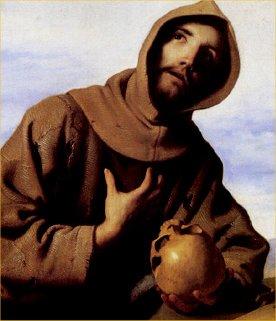
There’s an old story about Francis of Assisi. One day he informed his fellow friars that he intended to go into a nearby village on a preaching mission. He invited one of the novices to accompany him. On their way, they passed several poor, homeless folk who were in need, and each time, Francis stopped to help.

So it went, all through the day: one interruption after another. The sun was low in the sky when Francis told his companion it was time for them to return for evening prayers. But the young man objected: “Father, I thought you said we were coming into town to preach to the people.”

Francis only smiled. “My brother, that’s what we have been doing all day.”

On another occasion, Francis puts it even more succinctly: “Preach the gospel at all times. When necessary, use words.”

Thank God for friends like Anne, who reach out across the years with words of caring and concern: words that point to a God of love, who really does care about chemotherapy and white blood-cell counts, about comfort and friendship, about life and death!

Wednesday, January 25, 2006

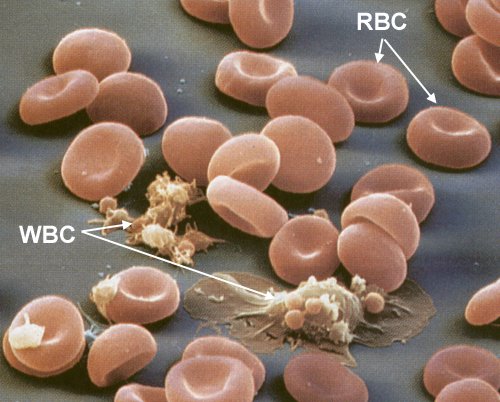
January 25, 2006 - Tales the Blood Tells

It’s one week to the day after my first chemotherapy treatment – so, first thing in the morning, I drive over to Dr. Lerner’s office for a blood test.

The procedure is the same as before. I’m led into the small room that I’ve been calling “the bloodletting room.” The phlebotomist greets me, pokes my arm, and extracts a test-tube full of blood (I’m getting very used to this routine by now). Then, as I hold a wad of gauze against the inside of my elbow, she turns to a nearby counter, on which sit two identical, gray machines – each about the size of those automatic bread-making machines that some people have in their kitchens.

With well-practiced motions, she pops the test tube into a little door on the front of one machine, presses a touchscreen, and – Presto! – a computer printer spits out two copies of my CBC (Complete Blood Count) report. It only takes about a minute.

One copy is for me to take home, the other for my medical file. Next, I’m sent down the hall into “the Nurses’ Room”: a larger room with glass-front medicine cabinets and a half-dozen patient chairs in a row against one wall. I’m the only one in this room at the moment – although, when I was here for my Neulasta shot last week, nearly all the chairs were filled with patients waiting to receive medication of one sort or another.

I hand over my file to Diane, the nurse who gave me my chemo medicines last week. A quick glance at the CBC report confirms “everything’s fine”: the levels of my white cells, red cells and platelets look just as healthy today as they were on the day I started my chemotherapy.

This is not likely to last, Diane warns. It’s a rare CHOP chemo patient who gets through all six treatments without experiencing a plunge in one or more of those key indicators. But for now, there are no restrictions on my activity. I can do as much or as little as I feel like doing.

I ask about hair loss. “Early next week” is the answer. Most patients lose their hair about 13 days or so after the first treatment, which for me would be Monday. But still, it’s hard to predict. Some patients take a little longer to lose it – in a few cases, not till after the second chemo treatment. It starts gradually: a few hairs on the pillow, or in the bathtub drain – though once it starts, it’s time to take action. Those hairs on the pillow are an early warning to get to the barber shop, or do whatever else is needful to prepare.

I walk outside into an amazingly warm and sunny day, for late January: the forecast today is for a high of 45 degrees Fahrenheit (7 Celsius). I get into the car, feeling encouraged – grateful for a beautiful morning, and for treatment that is (at least for the moment) very tolerable indeed.