Monday, November 20, 2006

November 20, 2006 - Anger

Today I come across a link to a blog written by another cancer survivor (brain, spinal and lung cancer). Leroy Sievers is his name, and he’s a writer and journalist – having worked for CBS News and ABC News. At one time, he was the executive producer of the Nightline television news program. Now he’s keeping a cancer diary much like this one, for National Public Radio.

Here’s something Leroy has written, reflecting on his last year or so of living with cancer:
“My body has changed in some ways that are obvious, and in others that aren't. I have a ridge in my skull where they cut it open to take out the brain tumor. You can feel the screws in the plates that hold my skull together. I'm heavier than I'd like to be. I put on weight when I was on steroids, and I haven't been able to work out much the last year. I hate the extra weight, though my doctors seem to think it's healthy.

Emotionally? Over the past year, I've hit the depths of sorrow, thrown in a little anger, too. Some hope, but probably not as much as I should have. Frustration. The whole gamut of human experience. And maybe that's one of the lessons here. In spite of the cancer, in spite of what we all go through, in the end, we're all just human. We're like everybody else. Except that we're not.

I try to make the most of my life these days. But I was really trying to do that before my diagnosis, too. My view of the future is a little cloudier; it's no longer open-ended. Not everything is possible anymore. I'm pretty much an optimist still, but that has been seriously tested, too.”


I’m interested to hear that Leroy mentions anger. I’m getting in touch with the fact that anger is an issue for me right now – sort of a delayed reaction to what I’ve been through.

During my chemotherapy, I simply didn’t have time for anger. I had to marshal all my emotional resources in the service of just getting by. The reality is, I’ve probably been stuffing my anger about the cancer for some considerable time. When I received first one clean PET/CT scan report, then another (in late May and early September) that was no time for feeling angry, either. I was supposed to feel relieved (and one part of me did, of course).

So what happens to all that suppressed anger? The answer seems to be that it’s coming out, inappropriately. I find I have a short fuse, these days, for petty frustrations. Other people around me have noticed it, too (in truth, they picked up on it before I did). It’s as though there’s a little voice in my head that keeps whispering, “You shouldn’t have to put up with this nonsense: you have cancer!”

I’m finding ways to procrastinate on things I should be doing – like dealing with the accumulated mail at home (comprised, still, of way too many medical bills and insurance statements, that only serve to remind me of my medical condition). Last month, I found it hard to get our 2005 income tax information to the accountant – tackling that job only at the last minute, just a day or two before the mid-October deadline for the extension I’d filed for last spring. Procrastination, of course, is a classic passive-aggressive reaction.

I have the most energy for creative endeavors, like writing and preaching. Having crashed hard into the brick wall of life’s limited duration, it’s as though the things that matter most to me are the things I create, things just may live beyond me. (Maybe, too, that’s why I felt so determined to apply for additional life insurance, during last week’s open-enrollment period.)

It’s possible that my cancer has bumped me up an adult-development stage. Back in seminary, we learned about psychologist Erik Erikson’s stages of adult development. The last three of his eight stages – with the typical ages and the challenges and tasks people typically face at those ages – can be described as follows:

Stage Six, Young Adulthood: 18-40 years, intimacy vs.isolation, love relationships
Stage Seven, Middle Adulthood: 40-65 years, generativity vs.stagnation, parenting
Stage Eight, Maturity: 65 years until death, integrity vs.despair, acceptance of one's life

According to Erikson, the 40s and 50s are the prime time for “generativity” – for creating that legacy we’ll leave behind when we die. What happens, I wonder, when a disease like cancer threatens to move the termination-point of life up a decade or two, or three? Does it mean, in my case, that cancer has abruptly shoved me forward, existentially-speaking, from “Middle Adulthood” into “Maturity” – way before I feel ready to be there? If that’s what I’ve been feeling (or, at least, worrying about), then it’s no wonder I’m feeling a bit angry. It’s the psychological equivalent of “the bends” – what scuba divers get when they surface too quickly.

How I sort all this out, I’m not sure. It’s clear that, remission or no remission, I’m still living with cancer, in an emotional sense.

Tuesday, November 14, 2006

November 14, 2006 - A Little Cancer Humor

I try to keep up with a few other blogs written by cancer survivors. One of them, My Private Casbah, by a New Orleans woman named Bint Alshamsa, is quirky, but amusing - sometimes even profound.

Here’s a bit of cancer survivor’s humor, from her November 2, 2006 entry. I realize it may not be for everyone.

You’ve gotta be able to laugh to get through an experience like this...

Thirteen Fun Things To Do When You Have Incurable Cancer
by Bint Alshamsa

1. If you're planning on getting married before you croak, you can always ask the florist for a discount by promising her repeat business in the form of exclusive rights to your up-coming funeral display.

2. Telling a mechanic that you need to get your car repaired so that you can drive to MD Anderson for a last ditch experimental treatment attempt for your incurable cancer is a good way to get him to finish with yours before he even starts on the dozen cars that were there before you.

3. If no one knows that the oncologist says you're in remission, you can get really good presents from your friends by telling them that this might be the last birthday/Eid/Christmas that you'll ever get the opportunity to celebrate and they'll want to make it a really good one for you.

4. You can eat whatever the hell you want. I mean it's not like you have to worry about having clogged arteries fifty years from now.

5. You can get your partner to "secretly" tell everyone at the family reunion that all of the medications you're taking are making you a bit delerious. After that you can go around throughout the day telling everyone who has ever pissed you off exactly what you've thought of them all these years. (Be sure to include a few jibberish statements every now and then to make it more believable.)

6. During chemotherapy, you can sleep for an extra thirty minutes every morning because you don't have to worry about fixing your hair before work.

7. You can surprise all of the radiation technicians by coming to your treatment wearing a bikini and telling them that you're ready for your tanning appointment.

8. When you're in the hospital hooked up to a bunch of tubes and machines, you can have a good laugh at your sibling's expense by telling all of your young neices and nephews that you got like that from eating too many vegetables as a child.

9. You can sleep in on election day. After all, who cares what candidate wins? It's not like you're going to have to live with them for the next couple of years. Or better yet, do go out and vote and tell everyone in line that you've been a life long(name of whatever political party you hate the most) voter but you're using the final election day of your life to vote for the other party because you've finally seen the light and decided to do the right thing for the first time before you die.

10. Having a few cancerous ribs removed from your chest will make it a lot easier to fit into those too-small clothes you've been saving in your closet.

11. You can tell people who don't know about your cancer that you got all of those scars from saving a small child from being mauled by mountain lions because everybody loves a hero.

12. When you go to the grocery store, always wear something that shows your radiation burns and leave your wig at home. Then when you get in the long line, you can ask people if they'd be so kind as to let you go ahead of them because you have to hurry up and get back home to your wife/husband/partner who is even more contagious than you are. I have it on very good authority that this one works great.

13. Make random strangers angry in crowded parking lot by parking in the handicapped spot and then using your cane as your partner as you do the Merengue all the way to the entrance of the building.

November 12, 2006 - Blessed Insurance

One small comfort, throughout this past year of living with cancer, is that I’ve got some life insurance. This would help provide for the needs of my family, should anything happen to me. My father sold me my first policy years ago, when I was still in seminary, during a time when he was briefly in the insurance business. Some years later, Claire and I each purchased another policy. Additionally, the church’s pension plan provides a modest “death benefit” – efffectively, a term insurance policy – whose payout decreases with age. (I’ve always found that phrase “death benefit” a little odd: an oxymoron, even.)

Do we have enough insurance? Probably not. But at least we’ve got something.

Lately, I’ve been thinking about buying more insurance – although I realize that, with my recent health history, that could be problematic. When a mailing arrived from the Presbyterian Church’s Board of Pensions a few weeks ago, advertising an open enrollment period for additional death benefits, I figured this could be my chance.

An earlier conversation with our regional Board of Pensions representative was somewhat reassuring. A cancer diagnosis, he told me, doesn’t necessarily disqualify me from coverage. It’s a group policy, so as long as I meet their basic medical underwriting requirements, and am willing to put up with a one-year “pre-existing condition” exclusion, there’s a possibility I could still be eligible. There’s no medical exam, just a barebones medical-history questionnaire.

What’s more, the cost is not affected by health circumstances (other than a separate rate table for smokers, which doesn’t apply to me).

We were talking about life insurance just last week, at the Cancer Concern Center support group. I found out that life insurance is a big issue for many cancer survivors. In many cases, if you don’t sign on the dotted line before being diagnosed, you’re either completely ineligible, or you’re subjected to such high premiums that you may as well be. The group seemed to think the Board’s policy sounded unusually generous.

There remains but one other obstacle to my filling out the application: an obstacle that’s within me. “What does it mean,” I keep asking myself, “that I want to get more insurance? Does it mean I’m giving up? Does it mean I believe, in my heart of hearts, that my remission is not going to last long?” Filling out the application seems a bit like an act of self-betrayal.

I’ve gotten over that. Today I complete the application, and leave it for our church treasurer to sign (I’ll pay the premiums myself, but it’s part of my employee benefits, so she has to sign off on it).

I still feel a bit uncomfortable about it, but I’ve put those uncomfortable feelings aside. Completing the application doesn’t mean I’m giving up. It means I’m looking out for those I love.

Monday, November 13, 2006

November 10, 2006 - Under My Skin

Another monthly port flush today. After nearly an hour in Dr. Lerner's packed waiting room (cancer has never been so popular, it seems), I'm ushered into an equally crowded nurses' room. Today it's an oil change for me, rather than a transmission job – so, they've squeezed my appointment in amongst a half-dozen or so patients who are receiving other treatments. Chemo bags hang from hooks on the ceiling over some people's heads (evidently, their treatment is still not long enough to qualify for a lounge-chair in the infusion room). Others move in and out very quickly: they're just here to get shots (Procrit, Neulasta, that sort of thing).

Most of them are considerably older than me: seventy- and eightysomethings. I'm just a newly-minted fiftysomething, but I've got a bum set of chromosomes much like theirs. Or, maybe, not so much like theirs. Mine went haywire a decade or two earlier, in terms of lifespan.

My nurse today is one I haven't seen before. She misses my deeply-implanted port on her first attempt at the docking procedure. Ouch. She tries again, but with a longer needle. This time it works. Pressing the plunger on the syringe, she injects saline solution into the vein buried deep within my chest. My heart muscle dispatches the stuff in the blink of an eye. A second later, I taste the plastic and feel the bubbling sensation in the back of my throat.

The words of an old jazz standard drift across my consciousness. "I've got you... under my skin." Yeah, I've got this little button under my skin, all right. There it will stay, until it's either needed again, or until the doctor decides it won't be needed for a long time. Let's hope for the second of the two alternatives.

My neighbor in the nurses' room, it turns out, is the mother of a woman whose wedding I performed about ten years ago. Her daughter is an inactive member of our church: still on the rolls, although we rarely see her. The mother recognizes me, and tells me all about her grandchildren. We don't discuss her cancer (I assume it's cancer – although, in this office, it could also be any one of a number of blood disorders). Nor do we mention mine. Just kids and grandkids. Life, in other words.

On my way out, I learn that my appointment with Dr. Lerner must be rescheduled. It seems someone in the office miscalculated the date, booking me for exactly three months from my last appointment. This doesn't account for the fact that the CT scan has to happen first – and that, they tell me, would place the scan on the calendar fewer than three months after my last one. "The insurance company would never approve that," they tell me. "If it's a day under three months, they'll bounce it right back." So, we push the doctor's appointment back a week or two, in order to allow time for the CT scan. My scan is now scheduled for November 30th, and my doctor's appointment for December 8th.

"I've got you... under my skin." I hum the catchy Cole Porter ditty to myself, on my way out to the parking lot. So what's really under there? An implanted port, for sure. But is there still more cancer?

Who's to say?

Wednesday, November 01, 2006

November 1, 2006 - The Big 5-0

Several days ago, in a quiet way, Claire and I celebrated my 50th birthday. The actual day was October 28th. I was up at our Adirondack camp (vacation cabin) near Jay, New York. I’d been up there for a week of study leave, writing furiously, as the deadline for my latest book, the third and final installment of the Lectionary Preaching Workbook series, approaches.

I didn’t bolt out of town to avoid a big birthday celebration. Really. It’s just that last week was the only possible week I could get away, this fall. It was Reading Week at New Brunswick Theological Seminary, so I didn’t have to teach my weekly, Thursday-evening course.

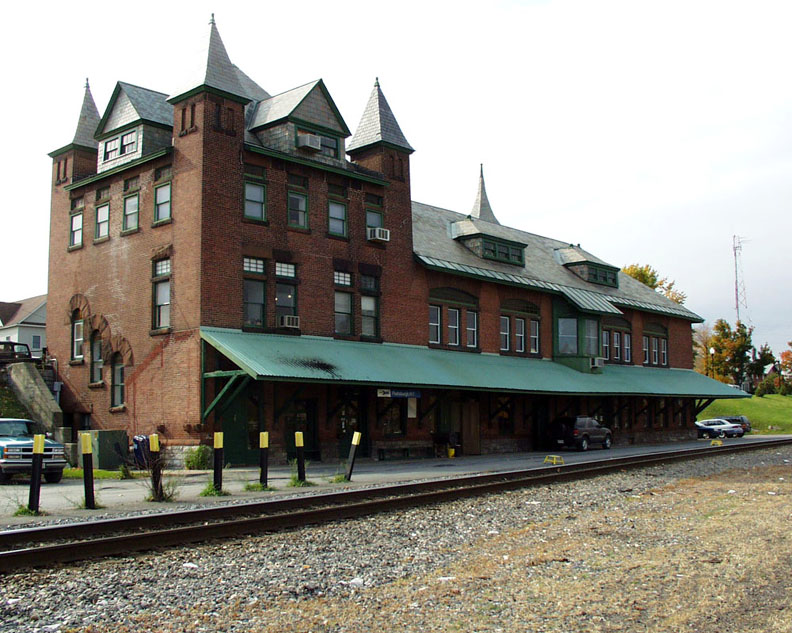
On my birthday, Claire rode up to join me, taking the Amtrak train to Plattsburgh, New York. As I met her at the classic, Victorian rail station, I was surprised at how few people got off the train – no more than 4 or 5 individuals. This is no out-of-the-way spur, I thought to myself. It’s the Amtrak main line between New York and Montreal. Claire’s was the only train of the day connecting those two major cities, and it was more than two hours late (equipment problems). It reminded me of how we’ve let our nation’s once-mighty passenger rail system slip into near-oblivion.

So, if you want to know how I spent my 50th birthday, at least part of the time I was waiting for a train. I have to admit that was better than the earlier part of the afternoon, though, which I spent in a dentist’s chair. I’d lost a temporary crown the evening before, and was fortunate, indeed, to find a wonderful dentist, Dr. Michael O’Connor, who agreed to open up his Plattsburgh office on a Saturday morning, even though I’m not one of his patients.

The irony of that experience wasn’t lost on me. It was my fiftieth birthday, and my teeth were falling out. Literally. Tempus fugit.
It was good to see Claire, though. After driving back to our little house, we went out for a nice birthday dinner at one of our favorite restaurants, overlooking the rushing rapids of the AuSable River. The next day we enjoyed some quiet times, watching the snowflakes swirl (thankfully, they didn’t stick; it was still a little too warm for that). At one point, we were treated to the rare sight of a doe and a faun, foraging for food just outside our window.


How do I feel about turning 50? To be perfectly honest, it seems kind of anti-climactic. The sturm und drang of my cancer experience overshadows any piddling anxiety I might otherwise have felt, concerning this milestone birthday.

I’m not upset about turning 50. In fact, I’m glad I’ve made it this far. I was thankful for a quiet day, in one of my favorite spots, with my best girl by my side.

Claire and I are talking about throwing a bigger 50th birthday party, for both of us (she passed that milestone herself, in July). That party will do double duty as a belated end-of-chemo celebration for me, and also to commemorate Claire’s 15th anniversary of ordination as a minister. We’ll probably plan that celebration sometime later this month, if we can find a date that works.

Milestone birthdays are significant events, for most people – but maybe less so, for cancer survivors. For us, any healthy day is a good day.

Sunday, October 22, 2006

October 22, 2006 - Power Grid

I conducted a couple of difficult funerals this week. No funeral is easy, but each of these involved men in their thirties – the sort of death that’s just not supposed to happen. One man died in a car accident, the other from stomach cancer that was diagnosed only four or five months ago.

Both funerals involved the familiar ritual of family and friends gathering at the funeral home, for what is blandly and euphemistically called “visiting hours.” In my more than 25 years of ordained ministry, I’ve been to more of these gatherings than I could possibly count. It goes with the territory, when you’re in ministry.

There’s not a lot that happens, during visiting hours (or so it would appear, to the untrained eye). After spending a few moments greeting the bereaved family and expressing words of sympathy, most guests simply sit or stand around, sharing small talk with neighbors. It’s one of the few occasions in life when all you have to do is show up.

Over the years, I’ve come to realize there’s a lot more going on during visiting hours. What the eye sees is but the tip of the iceberg.

There’s a new book called Social Intelligence: The New Science of Human Relationships, by Daniel Goleman, that’s been getting a lot of press. I haven’t read it, but from the reviews, it appears to have a lot to say about what goes on behind the scenes in many human interactions.

Based on psychological research, Goleman’s point is that a large portion of our emotional interactions are non-verbal, and take place on a subconscious level. In an October 10th essay in the New York Times, “Friends for Life: An Emerging Biology of Emotional Healing,” Goleman describes his findings:

“Research on the link between relationships and physical health has established that people with rich personal networks – who are married, have close family and friends, are active in social and religious groups – recover more quickly from disease and live longer. But now the emerging field of social neuroscience, the study of how people’s brains entrain as they interact, adds a missing piece to that data.

The most significant finding was the discovery of ‘mirror neurons,’ a widely dispersed class of brain cells that operate like neural WiFi. Mirror neurons track the emotional flow, movement and even intentions of the person we are with, and replicate this sensed state in our own brain by stirring in our brain the same areas active in the other person.”


Goleman reports that some researchers have used language like “the merging of two discrete physiologies into a connected circuit.” They think they’ve found evidence in brain chemistry to prove the existence of such a connection. While the physiology of this brain-to-brain link is highly speculative at this point, there does seem to be some circumstantial evidence that such a link exists: such as one study that asked women volunteers to submit to MRI imaging, while awaiting a mild electrical shock. When one of these experimental subjects waited alone, her anxiety level increased. When a stranger held her hand, her anxiety level was unchanged. Yet, when the woman’s husband held her hand, “she not only felt calm, but her brain circuitry quieted, revealing the biology of emotional rescue.”

No, there’s a lot going on during visiting hours in the funeral home – as people awkwardly mill around, seemingly doing nothing. They may not be consciously aware of it, but they’ve come there that day to plug into the power grid of spiritual and emotional support. By their mere presence in the room, they lend strength to their bereaved family, friends or neighbors.

Centuries ago, the Elizabethan preacher and poet John Donne penned these famous words, as he wondered, during a time of plague, whether the funeral bells from a nearby church might soon be tolling for him:

“No man is an island, entire of itself; every man is a piece of the continent, a part of the main. If a clod be washed away by the sea, Europe is the less, as well as if promontory were, as well as if a manor of thy friend's or of thine own were. Any man's death diminishes me, because I am involved in mankind; and therefore never send to know for whom the bell tolls; it tolls for thee.” ("Meditation XVII," from Devotions Upon Emergent Occasions)

One thing my cancer has taught me is the importance of these connections between people. We can be agents of each other’s healing.

Wednesday, October 11, 2006

October 11, 2006 - Chemo Brain?


One of the more controversial side-effects of chemotherapy is something called "chemo brain" – experiences of mild confusion, mental fuzziness or loss of memory that occur both during and after chemotherapy. Many doctors deny that chemo brain exists, as a discrete side-effect – seeing it as simply another aspect of the stress, fatigue and general emotional strain that are part of living with cancer. Many chemotherapy veterans, though, aren't so sure.

I can picture several members of the support group at the Cancer Concern Center discussing the subject, at one of the weekly meetings. "Oh, yes," they were saying, nodding their heads vigorously. "Chemo brain is real."

I also have a memory of asking Dr. Lerner about it, as he was briefing me on what side effects to expect, as I began treatment. His reply was that, yes, he'd heard patients use the term, but he hadn't seen anything yet to suggest there's a physical explanation for it. He sounded skeptical, although he didn't categorically rule it out.

Now, there's a new study that suggests that chemo brain is a real phenomenon, that may continue for as long as ten years after treatment. To quote from a Yahoo! News story of October 5, "Chemo Has Long-Term Impact on Brain Function" (based on a Reuters press release):

"The researchers, from the University of California, Los Angeles, found that women who had undergone chemotherapy five to 10 years earlier had lower metabolism in a key region of the frontal cortex.

Women treated with chemotherapy also showed a spike in blood flow to the frontal cortex and cerebellum while performing memory tests, indicating a rapid jump in activity level, the researchers said in a statement about their study.

‘The same area of the frontal lobe that showed lower resting metabolism displayed a substantial leap in activity when the patients were performing the memory exercise,' said Daniel Silverman, the UCLA associate professor who led the study.

‘In effect, these women's brains were working harder than the control subjects' to recall the same information,' he said in a statement."


The study appears to be of a relatively small group, whom researchers asked to perform simple memory tests while undergoing PET scans. Published in the online edition of Breast Cancer Research and Treatment, it focused on just "21 women who had surgery to remove breast tumors, 16 of whom had received chemotherapy and five who had not." The article doesn't mention whether researchers were focusing on certain chemotherapy medicines only, or whether they were generalizing to consider all chemotherapy.

Still, their findings are suggestive – although I imagine that further studies, with much larger numbers of subjects, will be needed to satisfy all skeptics.

For now, the present state of affairs will probably continue, with many doctors expressing doubts, while a significant number of patients provide anecdotal evidence that – from their point of view, anyway – chemo brain is real.

As for me, I can't say for certain that I've experienced it. Sure, in the days following each chemo treatment, I found it hard to read for any length of time, or to concentrate on complicated tasks. But I could simply attribute that to the fact that I was feeling lousy. I could have said much the same thing about times in the pasts when I've had the flu.

As for any long-term effects of chemotherapy on memory, I can't say I've noticed any of those, either. Sure, I find it hard to recall someone's name, on occasion – and there have been times when I've wondered whether that's a result of chemo brain – but I can't say for sure that's the cause. I'm going to turn 50 in a couple of weeks. You can't expect to get that far in life without the mental machinery casting off a few nuts and bolts.

Those of us dealing with cancer need to pay close attention to confirmed medical findings from research studies, but it also pays to listen to the anecdotal experience of others. That two-pronged approach to information-gathering is, I think, the best way.

Saturday, October 07, 2006

October 7, 2006 - Rituxan Research Marches On

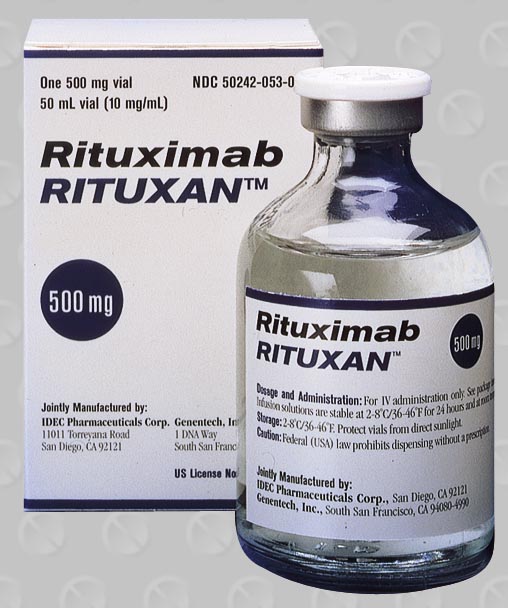
I've recently learned that Rituxan – the miracle drug that likely played a large role in the successful treatment of my cancer – has just been approved by the FDA for even wider use.

If I'm reading the Genentech company's press release correctly, Rituxan is now approved for use with another combination of chemo drugs other than CHOP: a drug cocktail known as CVP (cyclophosphamide, vincristine and prednisolone). This is for patients with follicular non-Hodgkin lymphoma – the indolent (or slow-growing) form of the disease. Rituxan is also now approved for follicular lymphoma patients whose disease is "stable," as well as for those relapsed patients who have already had treatment with CVP.

This news probably doesn't apply to me, personally, because my "diffuse mixed large and small cell" grading is considered to be an aggressive form of NHL (which means I'm already approved for treatment with Rituxan). But, I'm glad to know this medicine is now available more widely, to make a difference in the lives of others.

This is a typical illustration of how new drugs come to be available. When pharmaceutical researchers come up with a new formula that's likely to help patients, and have completed all the laboratory tests at their disposal, they must then engage in a lengthy process of testing on human subjects, a process known as "clinical trials." Clinical trials are typically divided into several phases.

Phase one involves a handful of patients, who are monitored closely to make sure the new medicine is safe to give to humans. When it comes to cancer drugs, "safe" is a relative term. Many widely-used cancer treatments have harmful side effects. Ironically, some chemotherapy agents (including some of the ones I've received) are known carcinogens. This means the medicines themselves will cause cancer in a small percentage of people who receive them. Yet, this is an acceptable risk, because avoiding the drugs is statistically more likely to harm patients. (If, for example, a drug is 80% likely to put a lymphoma patient into remission, but will cause leukemia, down the road, in an unfortunate 3% of the people who receive it, those are pretty good odds.)

Fortunately, Rituxan – unlike many of the old-line chemotherapy drugs – has only minimal side-effects.

If there are no significant ill effects in the first phase, the trial moves on to phase two, in which a somewhat larger group of patients receives the drug. Researchers monitor this group not just with regard to safety, but also in order to test the medicine's effectiveness. Often, there must be a control group, randomly selected from among the pool of clinical-trial participants. Because it would not be ethical to give sick people only a placebo (a harmless substance, of no medical value), the patients chosen for the control group typically receive another, fully-approved cancer medicine instead. Clinical trial participants don't usually know whether they are in the study group or the control group. Patients who volunteer for such studies know they may have as much as a 50% chance of not receiving the promising new medicine, but they're generally willing to take that risk – because a 50% chance of getting it through a clinical-trial study is better than the 0% chance they would have of receiving it, had they stayed out of the clinical trial.

If phase two is successful, the researchers move on to phase three, in which the new product is tested on thousands of volunteers. If the medicine proves to be both safe and effective for a significant portion of this group, then it finally receives government approval for general use.

Research continues, then, through phase four: follow-up studies that examine the long-term risks and benefits of the drug.

Clinical trials are the cutting edge of cancer treatment. That's the reason many patients – particularly relapsed patients, who are running out of other options – sometimes travel great distances to be part of them. They're especially appealing to the uninsured and the underinsured, because drug companies typically make the medicines available to test subjects for free. Typically, clinical trials – especially phase three trials – are simultaneously offered in a number of leading treatment centers around the country, and even around the world. The theory is that this puts the new medicines within reach of as large a number of patients as possible.

It's quite a process – and very costly for the pharmaceutical companies to go through. That's the reason each of my six Rituxan doses had a list price of $7,000 (although the price was somewhat reduced for me – as it is for most patients – through contractual agreements between my medical insurance company and the doctor). Thankfully, my medical insurance covered most of it.

Pharmaceutical research is big business, no doubt about it: but it's a business that, when everything is said and done, saves lives.

Friday, September 29, 2006

September 29, 2006 - Access Point

Last night, I was up at New Brunswick Theological Seminary, for my weekly teaching stint (I teach a course called “Presbyterian Studies,” for Presbyterian ministerial candidates enrolled in that Reformed Church in America seminary). During the chapel service, the worship leader invited the assembled faculty and students to offer sentence prayers – brief, spoken intercessions.

Silently, I listened to the concerns raised by others. They were exactly the sort of items you’d expect to hear, in a seminary chapel service. There were general intercessions – for peace in the world, justice for the oppressed, safety for soldiers in Iraq, insight in academic study. There were also some specific prayer requests: first names of people, along with brief explanations of their circumstances. Someone had just lost a spouse, someone else was unemployed, still another person was hospitalized.

Then, someone offered prayer for “people who have cancer.” Suddenly, the service got very, very personal for me. I’d been letting the words of the prayers wash over me, with a kind of detached interest. When I heard those words, I found myself in a different place. I wasn’t just praying. I was being prayed for.

The man who voiced this concern surely wasn’t thinking of me, in particular. I’m an adjunct professor – a visiting firefighter, who teaches his class, then goes home. That makes me a virtual stranger to most of the seminary community. Of those who do know me, only a few are aware of my recent medical history. The man who offered this prayer for cancer patients probably started out with someone altogether different in mind, and kindly extended his concern to embrace others.

I was touched, all the same. I smiled to myself, realizing that the people to my left and right probably had no idea they were praying for me, as they joined their thoughts to those of the speaker.

We have a wireless access point in our house, allowing various computers to log onto the Internet. Anyone who turns on a laptop, within the limited range of that antenna, can make use of the connection. Because the device includes a built-in hardware firewall, I haven’t felt the need to enable its password-protection feature. I figure that anyone who should happen to power on a laptop in a car outside our house is welcome to ramp onto the information superhighway, toll-free. If whole cities, like Philadelphia, are equipping their business districts with free, wireless Internet access, then why shouldn’t I offer a similar gift to the universe?

I was on the receiving end of a similar kind of generosity last night, in the seminary chapel. That sentence prayer was like a wireless access point. I found myself in range, so I connected.

Reflecting on the experience of prayer, Roberta Bondi likens it to family ties:

“We often have a kind of notion, as part of this highfalutin’, noble picture of ourselves as pray-ers, that when we pray we need to be completely attentive and we need to be fully engaged and we need to be concentrating and we need to be focused. But the fact is, if prayer is our end of a relationship with God, that's not the way we are with the people we love a large portion of the time. We simply are in their presence. We're going about our lives at the same time in each other's presence, aware and sustained by each other, but not much more than that… However we are, however we think we ought to be in prayer, the fact is we just need to show up and do the best we can do. It's like being in a family.”

It just goes to show – when we are so bold as to offer up a prayer to God, we never know who may be in range.

Monday, September 25, 2006

September 25, 2006 - Need to Know

The other day, Claire told me of a woman she knows, whose husband has cancer. Over the past year or so, the two of them have compared notes, sharing how their respective spouses have been doing.

Evidently, this man and I have different styles of coping with the disease. Claire describes my style as “researching it to death.” Her friend’s husband is different, a bit less direct. “Tell me what I need to know,” he typically says to his doctor. “The rest I don’t want to hear about.”

I’ve been thinking about Claire’s “researching it to death” description, ever since. It’s true. I’ll admit it: I have responded to the news of my diagnosis and treatment by trying to unearth as much information as I possibly could. Sometimes, to the point of obsession.

It’s not that I distrust the doctors. I’m not trying to second-guess anyone. At each decision-point in the treatment process, I’ve followed the doctors’ recommendations exactly. On the one occasion when there was a difference of opinion (between Dr. Lerner and Dr. Portlock over the advisability of post-chemo radiation treatments), I stepped back and let the two of them duke it out. Dr. Portlock – an internationally-known lymphoma specialist in a research hospital – had seniority, so her opinion prevailed. It never occurred to me to try to put my finger on the scale, to try to influence the outcome.

I may have learned some medical jargon along the way, but I’m under no illusion that I’ve achieved the slightest ability to weigh the pros and cons of treatment decisions myself. “Do not try this at home” is a rule that works for me.

Nor do I have much patience with alternative therapies – rumors about the latest vitamin craze, that sort of thing. Yes, cancer is a complex and mysterious disease, but there are also vast amounts of human and material resources being devoted to research. Should I value some whispered product endorsement from some non-medical person, over the results of cancer trials from places like Memorial Sloan-Kettering and the University of Pennsylvania Hospitals? I don’t think so!

But still, I’ll continue to read, to web-surf, to attend conferences, so I may find out all I can about this fast-changing field.

I have a need to know, you see.

Monday, September 18, 2006

September 18, 2006 - Hope on the Medical-Research Front

Today, in my e-mail inbox, I come across a link to an article about a new research development in the treatment of Non-Hodgkin Lymphoma. Evidently, there’s a new drug currently in clinical trials, called Epratuzumab. Used in combination with Rituximab (trade name, Rituxan – the drug I got along with my chemotherapy), Epratuzumab shows promise in the treatment of relapsed NHL patients.

I’m in remission now, and I hope that I’ll stay there for a very long time. Yet, from time to time the thought occurs that one day I could go for a scan, and the cancer will have come back. I’ve done a little reading, to find out what would likely be the next step, when and if it does.

I don’t think I’d receive the CHOP chemo cocktail I received before. Most patients, I’m told, only receive that combination once in a lifetime (in fact, I read somewhere that 8 doses of CHOP is the lifetime maximum; I received 6). With relapsed cases, the doctors typically try something different.

There’s always the possibility of stem-cell transplant, as well – which is basically a method that allows patients to be treated with very harsh chemotherapy drugs. These chemo drugs are so powerful that they completely destroy the immune system, and therefore – without some intervention – would indirectly kill the patient, who would succumb to another illness or infection. Accompanied by a stem-cell transplant, though (using either the patient’s own, self-donated stem cells, or cells from a compatible donor), these heavy-duty drugs can be made safe to use. The doctors can allow the chemo drugs to go ahead and take down the immune system, because they can then use the transplanted stem cells to re-create it.

Another option is radioimmunotherapy – most notably two drugs, Bexxar and Zevalin, that actually carry tiny, radioactive particles directly to cancerous cells.

I suppose there could also be the possibility of radiation therapy – although that’s not usually indicated as a primary treatment for NHL. If I get radiation, it would probably be as a follow-up to some other treatment.

Any one of those options – another round of chemotherapy, radioimmunotherapy, radiation, or megadose chemotherapy with a stem-cell transplant – is a daunting prospect. It’s encouraging to hear of another monoclonal antibody treatment, similar to Rituxan, that shows real promise.

The world of NHL treatment is changing constantly. However far into the future my remission may last, when and if I do relapse, I will face an expanded array of treatment options. And that’s encouraging.

September 17, 2006 - Seafood Festival

Today, I walk a short distance down the street to the Point Pleasant Beach Seafood Festival – the biggest civic event of the year in our little town. The two busiest streets in our downtown business district are closed off, and lined with various booths offering craft items and non-profit organization literature. There's an entertainment stage as well, but by far the biggest draw is the booths sponsored by local seafood restaurants – of which, as a beachfront resort community, we've got many.

The closed-off streets are packed with people: so many, it's hard to walk. In a typical year, something like 40,000 people attend the Seafood Festival. This year's not so typical, because the event was postponed one day, due to the threat of rain (only a threat, as it turned out; yesterday was gorgeous, and would have been a perfect Festival day). The event got bumped to today, a Sunday – which caused its own set of problems for us in the churches.

It didn't occur to anyone from the Chamber of Commerce or the Borough Council to tell us, in the churches, that the rain-date starting time had been changed. (In past rain-out years, the Festival's started at noon – which was tough, but not impossible, for the churches.) This year's 10:00 start time took us by surprise. Knowing that, after 9:00 a.m. or so, there would be no parking places to be had within many blocks of the church, we made the decision late on Friday to cancel our 11:00 Sunday service. The 9:00 service was sparsely attended - by people who either live close enough to walk, or who got here just ahead of the onslaught.

Today, I'm feeling pretty angry at our municipal leaders, for blatantly overlooking the churches in their planning. In my sermon, I preach about the declining influence of churches in American life. There's a whole movement today, known as the emergent church movement, that shrugs and says "you can't fight City Hall" on this one: that churches had better just get used to the fact that the old era of civic religion in America is ended, and that our culture is careening headlong into secularism. We Christians had better start seeing ourselves, the emergent-church gurus warn, in a new way – before it's too late. The twenty-first century American church is not so much a valued community institution, as a mission outpost.

In the old days of civic religion – back when the Seafood Festival was known as “Big Sea Day” – elected officials wouldn’t have dreamed of closing the streets in front of churches on a Sunday morning, without someone at least picking up the phone and telling the churches what they proposed to do. Now, they just do it – with no apology and no explanation.

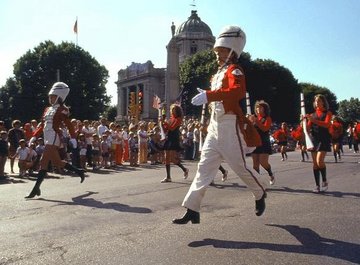
(Historical photo: "Big Sea Day," ancestor of the Seafood Festival)

Still, it's a beautiful day – so, after worship, I change into casual clothes and go walking into town. I rub elbows with a lot of people I know – which is no surprise, because we've lived here almost 16 years. Many of the people I encounter ask me how I'm feeling, or make some supportive comment like "You're looking good" (remembering, no doubt, the days when they saw the hairless me pushing a shopping cart through the supermarket, or dropping off a book at the library). With each new encounter, I repeat the news that I've just had a good 3-month checkup at the doctor's, and my scan results were good.

I realize there's a sort of time lag going on here. Close friends, family and church members have been able to observe my progress more closely. The medical news I'm sharing today feels like old news to me, but to the people I'm talking to, it's current.

I'm not complaining, of course. I'm glad they remembered to ask. A cancer diagnosis creates ripples throughout an entire community. The people who are further out from the point of impact are affected much later.


We're all connected, though. And that's a good thing.

Monday, September 11, 2006

September 11, 2006 - The Terror: Five Years Later

Today's the five-year anniversary of the 9/11 attacks. Yesterday, I shared my recollections of that day with the congregation in a sermon, "9/11: What Have We Learned?." Here's an excerpt:

I was sitting in the kitchen over at the manse, finishing my second cup of coffee and reading the newspaper, when Claire called from work. "Turn on the TV," she said. "I just heard something about an airplane hitting the World Trade Center."

I turned on the news, and there it was: those familiar images that are now burned deeply into our consciousness. Not long after, there came the pictures of the second airplane hitting the other tower. I had just spoken with Dottie and Diane, over in the church office, a few minutes before. They had heard the news on the radio. I called them back and said, "Come on over here. I think you need to see this. Let the answering machine take any calls. This is too important."

It seemed like the right thing to do. History was unfolding, minute by minute, and it didn't seem right for anyone not to see it. And besides – if truth be told – I didn't especially want to watch any more of it alone. It seemed like one of those times when people ought to be together.

A few minutes after Dottie and Diane came over, the three of us saw it: the collapse of the first tower, and then the second. Who would have thought such mighty works of engineering could come tumbling down so quickly, each floor collapsing onto the next? The sight was emotionally riveting, and absolutely horrifying, at the same time.

For some reason, that line from the first Star Wars movie came to my mind. Darth Vader has just deployed his dreadful weapon, the Death Star, to destroy the planet Alderan. Across the galaxy, Obi-Wan Kenobi sits up and takes notice. "I felt a great disturbance in the force," he says, "as if millions of souls cried out in terror and were suddenly silenced."

The human lives snuffed out in the twin towers were numbered in the thousands rather than the millions – but still, as we sat there and watched the towers fall, we could almost hear the cries of agony.

Late that afternoon, after Claire had returned home, she and I went down to the beach. We felt drawn there. Looking northward, into Monmouth County and beyond, we could see that smudge of smoke on the distant horizon: a dark plume, slanting to the eastward, as the prevailing winds slowly blew it out to sea.


The terrorist attacks of September 11, 2001 were one of those events – like the assassination of President Kennedy, the first steps of Neil Armstrong onto the moon, and a handful of others – that call forth a vivid recollection of exactly what we were doing when the news came through. There are few events that touch so many lives, that are truly a common experience for people of our culture. Yesterday, I knew – as I stood in the pulpit and shared the details of what I was doing that morning five years before – that everyone in that room over the age of 9 or 10 had gone through something similar.

How different that is from the events I have been narrating in this diary! Yes, there is a sizeable community of cancer survivors, but we are a minority (and may we ever remain so!). Write about the thoughts and emotions connected with watching the twin towers fall, though, and everyone has a similar story. Among the many thoughts that come to mind is an awareness of our mortality.

This morning, I glance through a special insert that came in yesterday's newspaper, containing photos and brief biographies of dozens and dozens of people from central New Jersey who died in the attacks. Most of them were beginning an ordinary work day, in offices on the upper floors of the twin towers. Some were rescue workers, who courageously entered the buildings, passing so many others who were streaming out. A few were there by accident – like one man, a telephone installer, who had the singularly bad fortune of being called in to install equipment in the Cantor Fitzgerald offices. Had his work order been dated a day earlier or a day later, he would have survived.

Five years ago today, I didn’t know I had cancer. Had I gone for an ultrasound on September 11, 2001, I don’t know if the technician would have detected anything out of the ordinary – although it’s possible the tumor was slowly growing inside me, even then. The question is academic – because, whatever genetic switch is encoded into my DNA, causing certain lymphocytes to go malignant, it was already there. As I watched the live newscast of the collapse of the towers and wondered, along with everyone else, what it’s like to die, who knows if the switch had already been thrown?

So many things in life, we just don't know about. And so, we live by faith. The opening line of the Brief Statement of Faith of the Presbyterian Church (U.S.A.) – which I shared with the congregation in my sermon yesterday – says it all:

"In life and in death, we belong to God."

Thursday, September 07, 2006

September 6, 2006 - Still in Remission

Late this afternoon, Claire and I drive over to Dr. Lerner’s office. After my port flush and blood draw, we take our seats in one of the small examining-rooms. Dr. Lerner comes in a few minutes later, opens my ever-thickening file, and begins poring over the reports from my PET and CT scans. He read the initial PET-scan results a few days ago, he tells us, but – due to the Labor Day holiday – he didn’t receive the reports from Friday’s CT scans until today.

Dr. Lerner confirms what I surmised earlier, from reading the PET-scan narrative report: I’m still in remission. The mass in my abdomen is still there, but it hasn’t changed in size since my previous scans (which were at the end of May). As for the nodule on the lung, it doesn’t appear to be of any concern – probably just some scarring from an earlier infection.

After viewing the abdominal mass on the second set of CT scans, the radiologist evidently went back and examined the PET-scan films in greater detail, then issued a supplementary report. That report does say there’s a possibility of some metabolic activity within what’s left of the mass, but it’s a very sketchy sort of conclusion. This is not uncommon with PET-scan results, Dr. Lerner tells us. He doesn’t think it’s at all significant, because the mass – which by now is likely only scar tissue – has not grown in size.

Is the radiologist genuinely concerned, after taking this second look at the test results? Or is he just being cagey – covering himself, legally, in the event that some future scan reveals a recurrence of cancer? For all the lab-coated practitioners of this modern alchemy would have us believe their conclusions are 100% objective, it turns out there’s still a certain amount of guesswork to it, after all. Is radiology, in some sense, an art as well as a science?

The bottom line, of course, is that this is very good news – although Dr. Lerner delivers it with the dispassionate objectivity of a true scientist. That’s OK with me. I don’t need a trumpet fanfare or a balloon drop. I sense Dr. Lerner to be, for all his soft-spoken precision and careful choice of words, a kind and caring man. He’s certainly done well by my case so far, and I’m grateful to him for that.


On my way out, the receptionist schedules me for another appointment, the week after Thanksgiving. I’m supposed to call the office a couple of weeks before then, to schedule another PET/CT fusion scan, and a series of regular CT scans. I’ll be back in the meantime, for my monthly port flush, but those will be quick, in-and-out visits – the oncological equivalent of getting an oil change.

As Claire and I leave the office, we walk arm-in-arm out to the car. Although this was the outcome we’d expected, it still feels good to have the weight lifted, once again. Three months from now, we’ll be going through this uncertainty all over again – as surely we will continue to do, for some considerable time to come. But that’s a worry for another day...

Monday, September 04, 2006

September 4, 2006 - Cancer and Wholeness

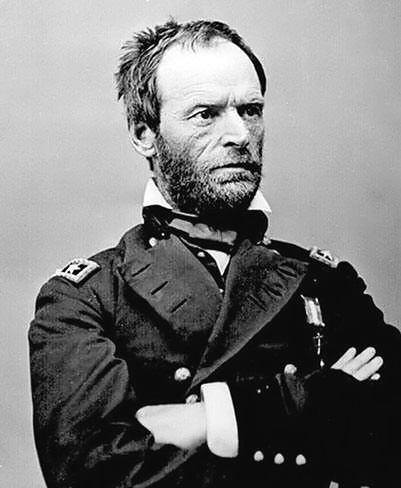
One of the most frustrating aspects of civilization's war against terrorism is that the adversaries are so hard to find. Something similar is true of cancer: it's only in certain circumstances that the enemy is clearly defined, and can be efficiently removed with a "surgical strike." More often than not, malignant cells linger, even after the scalpel's intervention. Grueling "therapies" – chemical, radiological – put the patient through hell, for a still-inconclusive outcome. But that should come as no surprise. "War is hell," said the infamous General Sherman, recalling the plumes of black smoke rising over the rooftops of Atlanta.

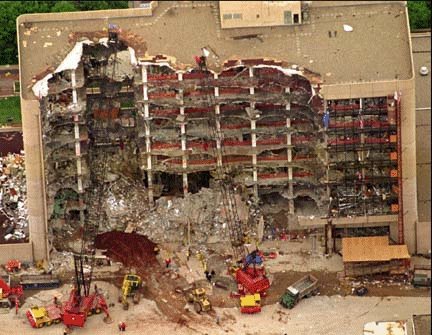
Yet, there's something about the military metaphor, applied to cancer, that doesn't quite fit. Cancerous cells are not some foreign invader: a band of terrorist commandos who slip across the border on forged passports, to blow themselves up, and us along with them. Cancer cells spring from our own loins. They arise from out of our own bodies, the result of genetic mutations that, despite science's best efforts, are still only dimly understood. If the terrorist metaphor applies at all, it's Timothy McVeigh and the Federal Building in Oklahoma City, not al-Qaeda and 9/11. We cancer survivors have met the enemy, and he is us.

I've quoted before from a little book of devotions called Now That I Have Cancer, I Am Whole, by John Robert McFarland (Andrews and McMeel, 1993). McFarland is a Methodist minister and colon-cancer survivor. Suzanne, a minister-colleague of mine and a friend of McFarland's, gave the book to me not long after I was diagnosed. Here's what he has to say about cancer and wholeness:

"In trying to beat cancer... I am competing against myself. Cancer is a part of me, so if I win, I also lose. Getting whole, getting well, has to do with oneness. It's not a matter of right or wrong, victory or defeat, not even life or death. It is life vs. nonlife. If I experience wholeness in life, death is not a defeat. If I experience fragmentation in life, then life is not a victory.

The goal, the sense of purpose, is not so much getting cured, beating the cancer, continuing to live. The goal is wholeness itself, being a full and complete person. That is adequate purpose. In fact, it is the only worthy purpose of life. I don't have to make some great achievement, do some mighty work, to justify my existence. Being a whole person is the purpose for our being.

There is no single road to wellness. Getting well and being well is taking an interlocking network of highways that lead to the one, central junction of wholeness"
(p. 48).

I’ve been thinking about my PET Scan report, that – as I read the medical jargon, anyway – indicates no sign of malignancy. That’s good news, something to celebrate. Yet, I also know, from my reading about Non-Hodgkin Lymphoma, that oncologists generally prefer to use the word “remission,” rather than “cure,” when talking about this kind of cancer.

It takes millions of malignant cells to create even the tiniest “hot spot” on the PET Scan film. That means hundreds of thousands of those cells could still be holed up in some dark, Tora-Bora cave within my body, subsisting below the radar of even the most sophisticated medical test – and the doctors know it. Even if the chemotherapy drugs and the Rituxan have wiped out every last malignant cell in my body, there’s nothing to stop some normal cell from going through the same mutation, starting the process all over again. If lymphoma’s plan of attack is coded into my DNA – as is entirely possible, and even likely – then who can prevent its return? There’s not a lot of closure, in treating NHL.

Evidently, that's true of some other forms of cancer, as well, as McFarland observes:

"Cure is an end-result concept. Wellness, health, healing, wholeness – these are process, each-moment-at-a-time concepts. I don't just want to be cured, to reach the end of one road. I want to be whole for each moment of all my life, whether my days are few or many" (p. 49).

I’m beginning to realize that this is the road map for my future. It’s always been the road map – indeed, it is for all of us – but the cancer experience reveals it with particular clarity.


You can’t wage war against cancer, any more than you can wage war against terrorism (as our nation is slowly learning). There are certain battles you can fight, but there’s no final resolution. The solution lies somewhere else. It lies within ourselves – where, by the grace of God, we may one day receive the wisdom to find it.

Friday, September 01, 2006

September 1, 2006 - An Encouraging-Sounding Report

This afternoon I go to Atlantic Medical Imaging for more scans – CT scans of the abdomen and pelvis, to be exact. Joanne from Dr. Lerner’s office phoned me yesterday, to say the doctor wants CT scans, in addition to the PET/CT fusion. She explained that the amount of detail visible on the fusion scan is not as great as he prefers to see.

Joanne managed to get the scan scheduled for the very next day – today – and got immediate pre-certification from my medical insurance. Because I’ve just had a CT scan of the lung on Monday (along the with PET/CT fusion), I don’t need to have that one re-done. Just the abdomen and pelvis.

Today’s scans go smoothly enough – drink the contrast fluid ahead of time, get poked in the arm for the IV contrast infusion, lie down on the table with arms over my head, hold my breath when the disembodied machine-voice tells me to – the usual.

As I’m talking to Kathy, the technician, I explain about the call from Dr. Lerner’s office, and how it happens that I’ve come in so soon again. I ask her if it’s a common thing for doctors to want a CT scan in addition to the PET/CT fusion, and she says it is. Some doctors will wait to see the report from the fusion scan before deciding they want the supplementary CT scans, while others routinely order both at the same time.

Reading between the lines of my question, Kathy tells me the narrative report from Monday’s scans is in my file, and offers to make me a copy of it. Sitting in my car in the parking lot after the test is finished, I wade through the medical jargon, and come upon these words:

“There is no abnormal hypermetabolic activity in the neck, skull base, abdomen, pelvis or upper thighs.” Towards the end, in the summary, the pathologist repeats, “No hypermetabolic activity to suggest pathologic lymphadenopathy in the neck, chest, abdomen or pelvis.”

Although I’ll have to wait for Dr. Lerner to confirm this when I see him this coming Wednesday afternoon, this sounds like good news to me.

As for the spot on the lung, there’s still something there, but it appears to be a bit smaller than whatever it was that showed up in May. It also appears to be of a non-cancerous nature.

From the narrative report of this past Monday’s CT scan:

“The centimeter sized nodule of interest is seen in the right middle lobe on the prior study. On today’s study, this area has an appearance more suggestive of scarring and is not hypermetabolic. This area also appears smaller on today’s study.... There is a triangular area of interstitial disease in a small portion of the superior segment of the right lower lobe... There is an area of scarring in the right middle lung. Just posterior to this, there is a tiny, triangle-appearing nodule approximately 2 mm also likely reflecting scarring. I do not see a centimeter sized nodule as was described on the prior reports within the right middle lobe.”

From the summary: “On PET/CT scan, also performed today, there is an area of hypermetabolic activity in the superior segment of the right lower lung corresponding to an area of interstitial lung disease on the chest CT. I would favor this to reflect an inflammatory or infectious etiology...”

Bottom line? As I read the medical jargon – and, again, I’ll have to wait to hear from Dr. Lerner for the final word – it looks like the lung abnormalities are scar tissue, from some past or present lung infection of as-yet-unknown origin.

It will be a lot easier to wait for Wednesday’s appointment, having read the encouraging-sounding PET/CT fusion report.